Cold email templates

Find inspiration from best-performing cold emails, sorted by categories.

Go beyond templates with AI-powered emails

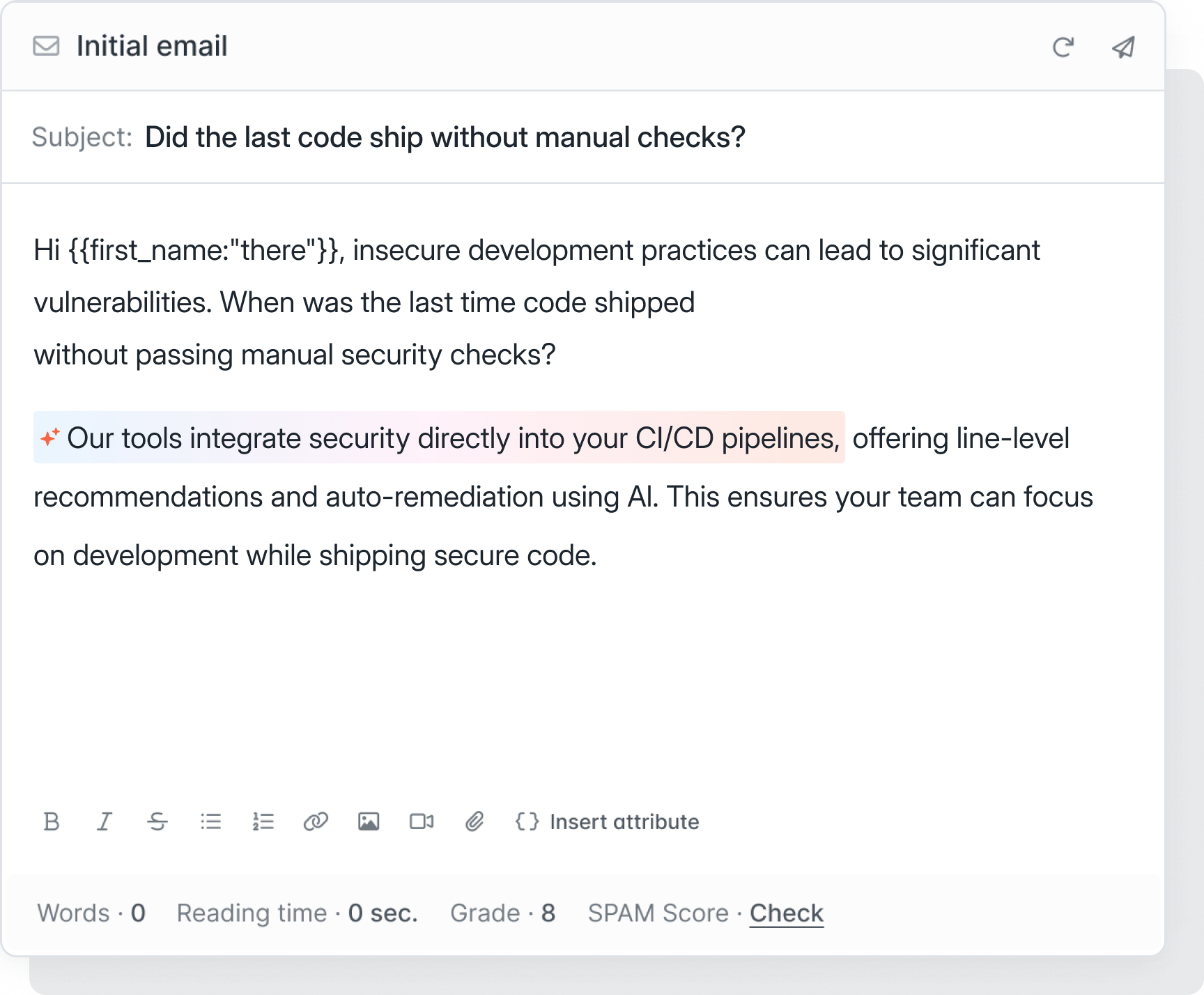
Templates are a great start, but the real secret to higher reply rates is relevance. Hunter’s AI Writing Assistant makes it easy to create emails tailored to each person in your audience at scale.

Try the AI Writing Assistant →
Categories
511 email templates
Thank you for the conversation, {{first_name}}

Hi {{first_name}},

Thank you for taking the time to talk today. The conversation was more useful than I expected, especially your point about [[specific insight or advice they gave]].

Here's what I'm going to do with it: [[1-2 sentences on the specific action you'll take based on their advice]]. I'll follow up once I have results to share.

If you're open to staying in touch, I'd welcome the chance to check in as things develop. If not, I'm grateful for today's conversation.

[[Your name]]

Following up: advice on [[topic]]

Hi {{first_name}},

I reached out last week about a question on [[topic]]. I understand you're busy, so I wanted to make the ask even lighter.

If a call doesn't work, I'd be grateful for your take on just one question by email: [[single, specific question that can be answered in a few sentences]].

Either way, I appreciate your time.

[[Your name]]

[[Mutual connection]] thought you'd be the right person to ask

Hi {{first_name}},

[[Mutual connection name]] suggested I reach out to you. I'm [[your name]], a [[your role]] working in [[your field]], and I'm navigating [[specific challenge or career decision in one sentence]].

[[Mutual connection]] thought your experience with [[specific area of their expertise]] would be particularly relevant. Would you have 20 minutes for a quick call?

I'll come with specific questions and respect your time.

[[Your name]]

Your [[talk/article]] on [[topic]]: a follow-up question

Hi {{first_name}},

I watched your [[talk, webinar, or read your article]] on [[topic]] and wanted to ask a follow-up question.

You mentioned [[specific point they made]]. I'm in a situation where [[brief description of how this applies to you]]. My instinct is to [[your current thinking]], but I'd like to pressure-test that with someone who's been through it.

Would you be willing to share your take? I'm happy to do this over email if a call is too much of a commitment.

[[Your name]]

Seeking advice on [[area]]: [[your name]]

Hi {{first_name}},

Your [[specific talk, article, interview, or body of work]] on [[topic]] is what prompted me to reach out. I'm at a stage in my career where [[brief description of your situation: e.g., "I'm transitioning from IC to management" or "I'm deciding whether to specialize or go broader"]].

I'd value your perspective on [[specific question or challenge]]. Would a 20-minute conversation be possible?

[[Your name]]

A question about [[topic they know well]], [[your name]]

Hi {{first_name}},

I'm [[your name]], a [[your role or stage]] working in [[your field]]. I've been following your work on [[specific topic, project, or content they've published]], and I'm facing a decision where your perspective would be more useful than anyone else's.

I'm working through [[specific challenge or decision in 1-2 sentences]]. Would you have 20 minutes for a call to share how you'd think about this?

I know your time is valuable and I'll come prepared with specific questions.

[[Your name]]

{{first_name}}: thought of you when I saw [[trigger]]

Hi {{first_name}},

I saw [[specific trigger: a news article about their industry, a company announcement, a trend related to their work]] and it made me think of our conversations about [[shared topic from when you were in touch]].

I've been [[brief update]]. Curious how things have developed on your end since we last spoke.

No agenda. Just wanted to reconnect.

[[Your name]]

Your [[article/post/talk]] on [[topic]] brought you to mind

Hi {{first_name}},

I came across your [[specific content: article, LinkedIn post, podcast, talk]] on [[topic]] and it brought our previous conversations to mind. Your point about [[specific insight]] was sharp, and it connects to something I've been working through on my end.

It's been a while since we caught up. Would you be open to a call?

[[Your name]]

It's been a while, {{first_name}}

Hi {{first_name}},

I realize it's been [[rough timeframe]] since we last spoke. I've been meaning to reach out and today felt like the right moment.

Quick update on my end: [[1-2 sentence career update]]. I'd love to hear what you've been up to. Would a coffee or a quick call work sometime in the next few weeks?

[[Your name]]

Catching up, {{first_name}}

Hi {{first_name}},

It's been a while since we last connected. I've been [[1-2 sentence career update]] and wanted to reach out to see how things are going on your end.

I saw [[something recent about them: a LinkedIn post, a company announcement, a project they shipped]] and it reminded me we should reconnect. Would you be up for a quick call sometime?

[[Your name]]

Page 1 / 43 Next
Hunter Sequences

Send better cold emails.
Get replies.

Compose sequences and schedule follow-ups, all from your Gmail or Outlook account. It's free.
Create a free account Learn more

How to write
a cold email?

  • Write a catchy opening line. To make your prospect read your cold email, in your opening line, mention a mutual connection, ask a relevant question, use a trigger event, or start with the prospect's problem.
  • Personalize your message. It makes sense to spend time on high-value prospects and manually add a personal touch to every email you send. You can have a single template for the outreach, but add very specific information for each of your prospects to make the message relevant to them and provide maximum value.
  • Keep it short and easy. There are three key elements your cold email should contain: who you are/or a short introduction, what your offer is, the action you want a prospect to take. Try to eliminate unnecessary greetings and wordy sentences.
  • Provide value. While writing your cold email, talk about the benefits prospects will get, not the features you sell.
  • Include a CTA. The CTA should have a perfect match with the goal of your cold email. Try to focus on a single thing you want to achieve with your outreach.
Read more: How to Write a Cold Email That Converts (Without Being Pushy)

How to write a
follow-up email?

While writing a cold email follow-up, you can follow the main principles we shared above for cold email writing. However, don’t forget about these principles as well:

Avoid sounding passive-aggressive. Direct aggression is relatively easy to spot, but more subtle passive-aggressive phrases can sneak into your follow-ups almost without thought. These kinds of microaggressions can exasperate your prospects and quickly chip away at the goodwill and all and mutual trust you have established. Hence, try to omit such passive-aggressive phrases in your follow-up emails:

  • I’m following up because you haven’t responded to me yet
  • I’ve tried to reach you a few times now
  • I know you’re busy, I’m busy too
  • Just checking in

Remove desperation. Yes, you might be upset because your prospect didn’t respond to your previous four follow-ups, but don’t show them your distress. These phrases are a right signal you sound a bit desperate, so try to omit them as well:

  • If it’s not too much trouble
  • I apologize in advance for bothering you

Craft a perfect subject line for your follow-up. Try not to be too apparent by having “Follow-up” or “Just checking in” as subject lines for your follow-ups. Be a bit more creative and write a catchy copy that makes users open your email.

Read more: How to Write a Follow-Up Email After no Response (With Examples)
Want help personalizing your cold emails? Hunter’s AI Writing Assistant generates unique, high-converting messages based on your audience and offer - helping you move beyond formulaic templates.

How to write
a good subject line?

  • Make it personal. Besides personalizing your cold email subject lines on a basic level (including first and company names), you can collect even more information about your prospects before reaching out to them and use it to improve your open rates. For example, it could be their position, industry, mention of the content they wrote, the place you met, etc.
  • Keep subject lines short. It’s easier to catch a prospect's attention with something short, sweet, and straight to the point. Besides that, it’s important to keep subject lines short because they will get cut off if they are too long, especially on mobile devices.
  • Ask questions. If you ask a question relevant to your prospects, they are more likely to open your email and start looking for the answer. Try to use open-ended questions since they are arousing curiosity.
  • Use power words. Power words are words of persuasion that often evoke an emotional response and lead to the desired outcome. They engage the reader's imagination and make them open emails. Here are some of the power words examples you can use for subject lines: astonishing, key, private, best, official, expert, simple, easy, ready, etc.
  • Don’t use clickbait. It doesn’t make sense to create “loud” subject lines for your cold outreach campaign. In the end, what matters is a conversion rate, not the open rate of your emails.
Read more: How to Craft Perfect Cold Email Subject Line
We use cookies
We use cookies to analyze how Hunter's website is used and personalize your experience. Learn more