Cold Email for a Job Templates

Browse best-performing cold email templates for job seekers reaching out directly to hiring managers, covering what to say, who to contact, and how to write a message targeted enough to stand out from the applications that followed the formal process.

Categories
6 email templates
Following up: [[your skill area]] and [[company]]

Hi {{first_name}},

I sent a note last week about my interest in [[company]] and my background in [[skill area]]. Since then, I noticed [[recent company news, product update, or article]] that reinforced why I want to be part of this team.

I'm not looking for a commitment. Even a 15-minute call would help me understand whether there's a fit worth exploring.

[[Your name]]

[[Mutual connection]] suggested I reach out about [[company]]

Hi {{first_name}},

[[Mutual connection name]] suggested I reach out. I'm a [[your role]] with experience in [[relevant area]], and [[mutual connection]] thought my background in [[specific skill or project]] might be a good fit for your team.

I'd welcome a short conversation to learn more about what you're working on and share a bit about my background. No pressure if the timing isn't right.

[[Your name]]

Your [[specific project or initiative]] at [[company]]: a connection

Hi {{first_name}},

I came across [[company]]'s work on [[specific project, product feature, or initiative]] and recognized a direct connection to what I've been doing.

At [[your current or recent company]], I [[specific accomplishment that mirrors their project]]. The overlap is strong enough that I wanted to reach out directly rather than wait for a posting.

Would it make sense to connect for 15 minutes?

[[Your name]]

No open role, but a strong fit at [[company]]

Hi {{first_name}},

I'm not aware of current openings on your team that match my background, but I wanted to introduce myself in case the timing works out.

I've spent [[timeframe]] working on [[relevant experience area]], most recently [[one sentence on a specific project or accomplishment]]. The way [[company]] approaches [[specific aspect of their product or strategy you admire]] is why I'm reaching out to you specifically.

Would you be open to a brief conversation?

[[Your name]]

[[Your role or skill]], interested in [[company]]

Hi {{first_name}},

I'm a [[your role]] with [[years]] years of experience in [[your domain]]. I've been watching [[company]] closely since [[specific trigger: product launch, funding round, recent news]], and I'd like to explore whether there's a fit on your team.

Here's what I'd bring: [[one sentence on your most relevant experience or result]]. I've attached my resume for context.

Even an informational conversation would be valuable. Would you be open to it?

[[Your name]]

Background in [[your skill area]]: potential fit at [[company]]

Hi {{first_name}},

I've been following [[company]]'s work on [[specific initiative, product, or project]], and my background in [[your skill area]] maps directly to what your team is building.

Most recently, I [[one sentence about a relevant accomplishment or project]]. I think that experience would be a strong fit for the kind of work your team is doing in [[specific area]].

Would a 15-minute conversation make sense?

[[Your name]]

Hunter Sequences

Send better cold emails.
Get replies.

Compose sequences and schedule follow-ups, all from your Gmail or Outlook account. It's free.
Create a free account Learn more

Frequently asked questions

If you can’t find the answer to your question here, visit the dedicated section in our Help Center.

Visit the Help Center

"I've been following your work on [initiative] and my background in [X] maps directly to what you're building" gives the hiring manager a reason to keep reading. Compare that to "I've always been passionate about the tech industry," which tells them the email was sent to thirty companies.

A cold email to a hiring manager should cover who you are in one sentence, why this company (not just the industry), what you bring that is relevant, and a simple ask. The "why this company" part requires real research: a product you use and have thoughts on, a recent initiative you read about, a problem the company is working on that connects to your background. That research is what separates an email that gets a reply from one that gets archived.

Look for someone who would directly manage the role you're interested in, not just HR or a general recruiter inbox. A direct manager is more likely to be interested in a proactive introduction and has more authority to create an opportunity or fast-track you into an opening that hasn't been posted yet.

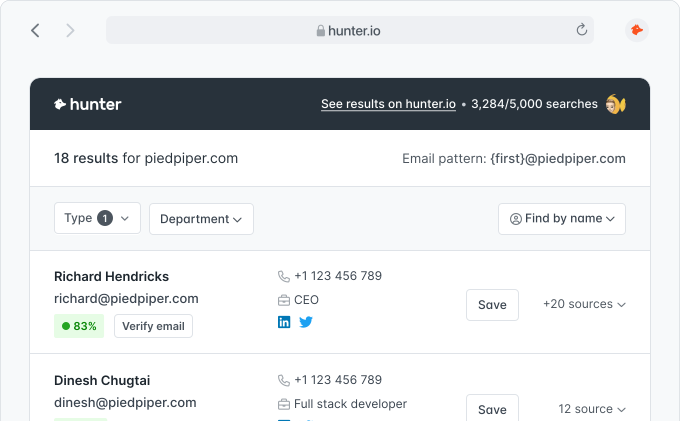
Once you have the company's domain, Hunter's Domain Search lets you filter contacts by role, so you can find the hiring manager or department lead directly without guessing at email formats. A direct email to the right person gets read faster than a message sent through a generic careers inbox.

Subject lines that name your expertise and connect it to the company get more opens than vague ones. "Background in [area]: potential fit at [Company Name]" names your offering before the email is opened. "[Your Role or Skill], interested in [Company Name]" is direct and tells the reader this is a professional introduction, not a mass application.

Avoid "Job inquiry" or "Looking for opportunities." Both are passive and tell the reader nothing distinctive about you.

Ask for a conversation, not a job. "I'm not aware of current openings that match my background, but I'd welcome the chance to introduce myself in case something comes up" is the right framing. Asking them to create a role for you is a harder sell than offering a conversation.

A proactive email sent to the right manager at a company you want to work for can surface opportunities before they're posted. Many roles are filled through networks before going to job boards. An email that arrives at the right moment, from someone who clearly understands what the company does and can articulate a fit, can turn into an informational call that turns into a hire.

69% of decision makers say it bothers them when they suspect an email was written by AI, according to Hunter's State of Email Outreach. But the resistance isn't to AI itself. It's to emails that feel templated or written for no one in particular. An email drafted with AI that references a real project, names the right team, and reads like one person writing to another will outperform a manually written template sent to thirty companies.

What hiring managers filter on is relevance. An email that mentions something they actually worked on, connects your background to a real problem the team is solving, and makes an ask that fits the situation reads as personal regardless of how it was produced. That level of targeting requires more research per email. It also produces meaningfully better results.

We use cookies
We use cookies to analyze how Hunter's website is used and personalize your experience. Learn more