Better deliverability
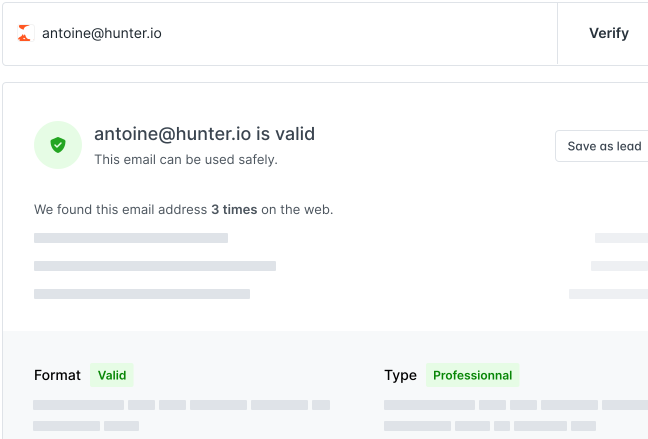
Keep your campaign bounce rates below 2% and improve your email deliverability with verified data.
Don’t let bad email addresses ruin good campaigns, spoil in CRMs, and lead AI agents to hallucinate leads. Verify any email address for free, or upgrade and make sure your whole list is safe to contact.
 4.6 on Capterra
 4.4 on G2




Keep your campaign bounce rates below 2% and improve your email deliverability with verified data.
Regularly verify your CRM data to focus on real contacts at real companies, so that your resources are spent on real leads.
Avoid spam traps, honeypots, disposable addresses, and risky email addresses to keep yourself out of blocklists.
Paste an email address, upload a list of addresses, or connect Hunter to your CRM, AI, or product via API.
Hunter checks the format, flags gibberish, disposable, webmail, and accept-all addresses, then looks up the domain’s MX records and runs a live check against its SMTP server.
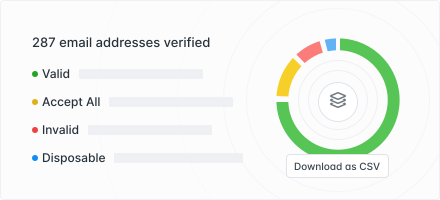
You get a status (valid, accept-all, invalid, disposable, or unknown) and the sources behind it, so you know whether the address is safe to send to.
Hunter’s verification tool is used by millions of businesses across the world.
“After switching to Hunter, we saw a 15-20% improvement in being able to determine whether an address is valid or invalid.”


With Hunter, you don’t have to choose between high-quality data and compliance. We source our data transparently and help you comply with data protection regulations.
Discover our principles
Verify from your AI agent, upload a list, call the API, or work straight in Google Sheets.
Connect Hunter over MCP or the API, and let your agent verify addresses and check deliverability before you send.
Access Hunter's MCPNeed to verify a list of emails? Upload your list and get your results in just a few clicks.
Bulk Email VerifierBring Hunter into your own product by using the Email Verifier API.
Email Verifier APIGenerate leads, build automations, and create AI solutions with Hunter’s verified B2B data.
If you can't find the answer to your question here, visit the dedicated section in our Help Center.
Visit the Help CenterAn email verifier (email checker) is a piece of software that checks if a given email address exists, and if it can receive an email you send. Email verifiers run email addresses through multiple tests to accurately assess their validity and existence, and show you a result for each verified email address.
Using an email verifier is important before contacting email addresses you didn't email before, or when it's been a while since you last reached out. This is because wherever you find email addresses, including your own database, they can be:
Below is a description of all email checks performed by the Email Verifier on every email address:
We wrote an article explaining how email verification works.
Hunter returns one of five statuses, and you're only charged for three of them.
A verification costs 0.5 credits on the All-in-One Outreach plans and 1 verification credit on Data Platform plans. Verifying the same address again in the same month is free, though bulk uploads are always charged.
Not with full certainty, and nor can any other tool. An accept-all (catch-all) domain is configured to accept mail for every address on it, including ones that were never created, so an SMTP check returns OK whatever you ask it. Hunter marks these as accept-all rather than guessing, and filters out made-up name-variant addresses so what's left is more likely to be a real mailbox.
Expect accept-all addresses to bounce at around half your list's invalid rate: if 10% of your list is invalid, roughly 5% of the accept-all addresses may bounce. Our guide to accept-all addresses has the experiment behind that number.
A valid result means the address passed every check Hunter runs and is safe to use, but verification is never 100% certain: it reflects the mailbox at the moment it was checked. A small percentage of valid addresses still bounce, because mailboxes get deleted, fill up or start rejecting mail afterwards and bounces can come from deliverability problems on your own sending domain too, not just from the address. That's why it's worth verifying shortly before you reach out. If you see bounces on addresses you verified the same day, that's unusual: send them to contact@hunter.io with the bounce messages and support will look into it. The pitfalls of email verification covers the cases where every verifier struggles.
No, Hunter's email verification service doesn't rely on sending actual emails to the addresses being verified. Instead, we connect to the recipient's SMTP server to verify the address, and we use our knowledge about the given email domain.
If you recently verified an email address with Hunter's Email Verifier and it was verified as 'valid', then it's safe to use—provided your email server is configured well and your sender reputation is satisfactory. We usually observe a bounce rate lower than 1% for these email addresses. However, email verification can never prevent all emails from bouncing, because the existence and validity of the recipient address is not the only factor.
Yes, our email checker is free. The Free plan lets you verify up to 100 email addresses per month (0.5 credits each). If you need more email verifications, review our pricing.
Credits are shared across the Email Finder and Domain Search, where a search costs 1 credit, so how far they go depends on what else you use them for.
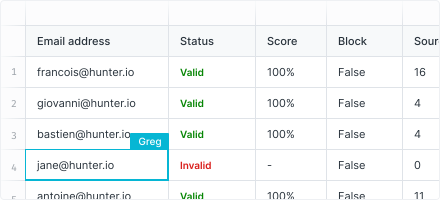
Yes, you can verify a list of email addresses with the Bulk Email Verifier, whether they are work addresses or personal ones. Hunter will run the same email verifications on your entire email list.
Because a model will invent an email address that looks correct. Asked for someone's contact details, it predicts the most likely pattern, firstname.lastname@company.com, and returns it with the same confidence as a real one. The address is plausible, it is not real, and you find out when it bounces.
We measured it. Across 1,604 model-generated addresses that got a conclusive verdict, 76% were invalid and only 14% verified as valid. The strongest model tested returned a valid address about 20% of the time, and famous companies fared no better than unknown startups: 71% invalid either way. Connect the same model to Hunter and that rises to 78%.
A verifier is the check between the model's guess and your send: it either confirms the mailbox exists or says it cannot, so the agent has a fact to act on rather than a guess. Hunter returns a status for every address, and says when it cannot verify one instead of guessing.
Verify right before you send. In an 8-week experiment on 1,278 addresses that started out valid, 2.3% had gone invalid and another 3.2% had turned accept-all by the end, so 5.5% of a carefully cleaned list was no longer safe to contact. More than 2% was already invalid after four weeks, and 2% is the bounce rate at which a cold campaign is worth pausing to troubleshoot. Contact data decays on its own as people change jobs and companies reconfigure domains to accept-all, so a list that was clean when you built it will not stay clean. On a paid plan Hunter re-verifies your contacts automatically every month, and email verification best practices covers how to fit it into a routine.
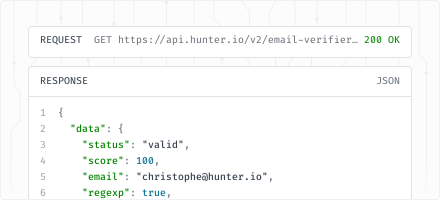
Yes, we offer a free API to all Hunter users. It provides the most flexible way of verifying email addresses. High-volume users can use our Data Platform plans to only pay for email verification, without access to other parts of the platform.
You can integrate Hunter's Email Verifier into your CRM. We have built native integrations with leading platforms like HubSpot or Pipedrive, and we can serve nearly every other platform through Zapier automations. For more, browse our Integrations or read how to integrate email verification with your CRM.
An email verifier can help you spot fake subscribers and submissions before they reach your database, either as a scheduled clean-up or as a real-time check inside the form. That protects your organization from two common attacks:
Contacting an address you didn't verify risks a bounce, and every bounce chips away at the sender reputation that decides whether the rest of your email reaches the inbox. Two things go wrong:
Email validation checks whether an email address is correctly formatted and appears to follow the syntax rules of email addresses (for example, name@domain.com and not namedomain@.com). It ensures there are no typos, extra spaces, or invalid characters. However, it doesn't confirm that the address actually exists.
Email verification goes a step further. It checks whether the email address is deliverable, that is, whether it can receive messages. A verifier typically connects to the mail server and simulates sending an email to confirm that the mailbox is active.
In short: validation ensures the email looks correct; verification ensures it exists. Our guide compares email validation and verification side by side.
There is none. “Email verifier” and “email checker” refer to the same tool providing the same service, one that confirms whether an email address is valid and deliverable. You will also see it called an email validator, an email tester, an email address checker or an email address verifier. They all describe the same job, though strictly an email validator checks the format rather than the mailbox.
A good verifier (or checker) doesn't just spot typos; it identifies invalid, risky, and accept-all addresses, helping you maintain a low bounce rate and stronger sender reputation.
In short: the two names describe one tool, so judge it on what it catches rather than what it is called.
Yes. The Email Verifier checks whether an address is valid and deliverable. To find out who is behind it, use the Reverse Email Lookup tool, which returns the person's name, job title, company, and social profiles from an email address.
Learn how to verify emails accurately, maintain a clean list, and ensure more messages land in the inbox.
A clear overview of how email verification works and why it’s essential for email deliverability.
A comparison of leading email verifiers to help you choose the most reliable solution for protecting your sender reputation and maximizing inbox placement.
Access original research, benchmark data, and experiments we’ve conducted to better understand accuracy, performance, and industry trends.
Sign up for free and
verify 100 contacts today.
More than 7,000,000 professionals use Hunter to build more connections and grow their business.

 Open in Claude Code
 Open in Cursor
 Open in Codex