Internship Email Templates

Browse best-performing internship email templates for cold outreach to companies and team managers, written to help you reach the right person before a role is posted and make a case targeted enough that they consider creating one.

Catégories
6 templates d'emails
A specific way I could contribute to [[team or project]]

Hi {{first_name}},

I've been studying [[company]]'s [[specific product, content, or public work]] and I have a concrete idea for how I could contribute as an intern.

[[2-3 sentences describing a specific project idea, analysis, or contribution you could make, grounded in their actual product or content. Not vague. Something they could picture.]].

I'm a [[year/program]] student at [[school]] with experience in [[relevant skill]]. If this kind of work is useful to your team, I'd love to talk about making it happen for [[season/year]].

[[Your name]]

Following up: internship interest at [[company]]

Hi {{first_name}},

I reached out last week about a potential internship on your team. Since then, I [[one new development: completed a relevant project, published something, learned something new that connects to their work]].

I'm still very interested in [[company]] and would value even a 15-minute conversation. If the timing isn't right for interns, I completely understand.

[[Your name]]

[[Professor or contact name]] suggested I reach out about an internship

Hi {{first_name}},

[[Professor or contact name]] suggested I reach out to your team about a potential internship. I'm a [[year/program]] student at [[school]] focusing on [[area]], and [[professor/contact]] thought my work on [[specific project]] would be relevant to what [[company]] is building.

I'd welcome even a brief conversation to learn more about your team and share what I've been working on.

[[Your name]]

[[Your skill area]] intern: interested in [[company]]'s [[team/product]]

Hi {{first_name}},

I saw that [[company]] recently [[specific trigger: shipped a feature, launched a campaign, published research, expanded a team]]. The work your team is doing in [[specific area]] is exactly the kind of problem I want to work on.

I'm a [[year/program]] student at [[school]] with experience in [[relevant skill]]. My most relevant project: [[1 sentence describing a project and the outcome]].

I'd love to contribute to [[specific area of their work]]. Is your team considering interns for [[season/year]]?

[[Your name]]

Summer internship: [[your skill]] and interest in [[company]]

Hi {{first_name}},

I'm not sure whether [[company]] is currently taking interns, but I wanted to write in case the timing works out.

I'm a [[year]] [[major]] student at [[school]]. Over the past [[timeframe]], I've been working on [[specific project with brief result or detail]]. That experience connects directly to [[their product area or team focus]].

I'd bring [[specific skill or capability]] and would contribute to [[specific type of work]] on your team. Would you be open to a short conversation?

[[Your name]]

Internship inquiry: [[your skill area]], [[season/year]]

Hi {{first_name}},

I'm [[your name]], a [[year/program]] student at [[school]] studying [[major]]. I've been following [[company]]'s work on [[specific product, project, or initiative]], and I'd like to explore whether your team takes interns.

I've been building [[specific project or relevant work]] in [[technology or skill area]], and I think that work could apply directly to [[their team or product area]].

I'm looking for a [[season]] [[year]] internship. Would a brief conversation make sense?

[[Your name]]

Hunter Sequences

Envoyez de meilleurs emails de prospection.
Obtenez des réponses.

Composez des séquences et programmez des relances, le tout depuis votre compte Gmail ou Outlook. C'est gratuit.
Créer un compte gratuit En savoir plus

Frequently asked questions

If you can’t find the answer to your question here, visit the dedicated section in our Help Center.

Visit the Help Center

"I've been building [project] in [technology] and I think that work could apply directly to [team or product area]" gives the reader something to evaluate. Compare that to "I'm a motivated student looking for a marketing internship," which tells them nothing they couldn't get from any other candidate.

A cold internship email should introduce you briefly, explain why you want to work at this company, describe the type of work you're hoping to contribute to, and ask about upcoming or informal opportunities. The framing matters more than the credentials. You're reaching out before any formal process exists, which means the email has to create enough interest for the reader to want to start one. That requires naming which team or department you're interested in, what kind of project connects to your skills, and why this company is your first choice.

Target someone who manages the team you want to work in, not the general HR inbox. A team or department manager who reads a strong, relevant email has the standing to create an informal opportunity. HR typically processes applications against existing open roles and rarely routes speculative emails to the right person.

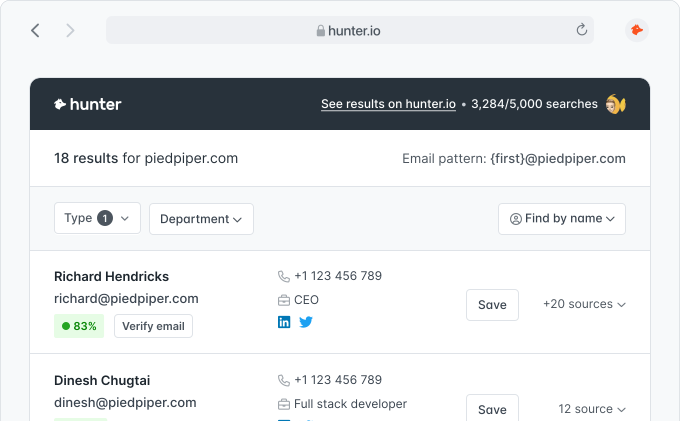
For startup and mid-size companies, the team page on the company's website often shows who leads each area, and a brief email directly to them is reasonable. For larger companies, Hunter's Domain Search lets you enter the company's domain and filter by department or job title to find the right manager's email address and LinkedIn profile. At any company size, avoid the generic careers inbox. It processes applications against open roles, not proactive introductions.

A subject line that names both your skill area and the company gets more opens than a vague application header. "Internship inquiry: [Your Skill Area], [Season/Year]" tells the reader who you are and what you're looking for. "Summer internship: [Skill] and interest in [Company Name]" front-loads the most relevant details.

Skip "Internship application" as a subject line. It reads like a formal submission to a process that may not exist yet.

Frame the ask as exploratory. "I'm not sure whether you're currently taking interns, but I wanted to write in case the timing works out" is the right tone. Companies that haven't posted internships often create informal arrangements for candidates who show real interest in particular work.

The key is making the email concrete enough that the manager can picture what you'd actually contribute. "I've been building [project] in [technology] and think that work could apply directly to [team or product area]" is more persuasive than "I'd love to learn from your team and contribute wherever I can." Naming the value you bring makes an informal opportunity easier for the manager to say yes to.

Sending the same email to every company on a list. Managers receive enough email to recognize a template, and an internship cold email that could have been sent to any company in the industry tells them you didn't care enough to research this one.

Hunter's State of Email Outreach found that 69% of decision makers are bothered when they suspect an email was AI-generated. Hiring managers are exactly that audience. But the problem isn't using AI. It's using it lazily. Instead of generating a generic pitch and blasting it to fifty companies, use AI to research each one. Pull what the team shipped recently, understand how your skills connect to their work, and write a pitch that makes that connection obvious. What used to take a full day of research now takes minutes, and the output is an email that reads like you spent real time on it.

Underselling your actual skills in favor of general enthusiasm is a close second. "I'm a hard-working, motivated student eager to contribute" could describe every applicant. "I've been working on [project] and I'm looking for a team where I can take that further in a real product context" gives the reader something to evaluate. Lead with what you can do, not with how willing you are to learn.

Nous utilisons des cookies
Nous utilisons les cookies pour analyser comment le site web d'Hunter est utilisé et personnaliser votre expérience. En savoir plus