Interview Follow-Up Email Templates

Browse best-performing interview follow-up email templates for thank-you notes, post-interview check-ins, and second-round follow-ups, crafted to reinforce your fit after the conversation.

Catégories
6 templates d'emails
Thank you for the update on [[job title]]

Hi {{first_name}},

I appreciate you letting me know. While I'm disappointed, I respect the decision and I'm glad I got to learn more about [[company]] through the process.

If a similar role opens up down the line, I'd welcome the chance to be considered again. The work your team is doing on [[specific project or area discussed]] is exactly the direction I want to go in my career.

Thanks again for your time and the thoughtful conversations.

[[Your name]]

[[Job title]]: timeline update from my end

Hi {{first_name}},

I wanted to share a quick update. I've received another offer with a decision deadline of [[date]], and I want to make sure I have the full picture before I respond.

The [[job title]] role at [[company]] is my strong preference, especially after our conversation about [[specific topic from interview]]. If there's any way to get an update on timing, that would help me make the right decision.

Appreciate your time on this.

[[Your name]]

Thank you for the [[job title]] final round

Hi {{first_name}},

Thank you for bringing me back for the [[second/final]] round. The deeper conversation about [[specific project or team goal discussed]] gave me a much clearer picture of the role and what success looks like in the first [[timeframe]].

After today, I'm more confident that my experience with [[relevant skill or project]] maps directly to what you're building. I'd be ready to hit the ground running on [[specific area discussed]].

I'll keep an eye out for next steps.

[[Your name]]

[[Job title]] role: quick update from my side

Hi {{first_name}},

Still very interested in the [[job title]] position. I noticed [[company]] [[recent company news or announcement]] this week, and it reinforced why I want to be part of this team.

Is there an update on the timeline? Happy to provide anything else that would be helpful as you work through the decision.

[[Your name]]

[[Job title]] panel: thank you, {{first_name}}

Hi {{first_name}},

I appreciated your questions about [[specific topic they raised]] during today's panel. That part of the conversation confirmed how much [[company]] values [[priority you picked up on]], which aligns closely with how I've approached [[related area]] in my current role.

One thing I didn't get to expand on: [[brief relevant point, 1 sentence]]. Happy to share more context if useful.

Thanks again for your time.

[[Your name]]

Thank you for the [[job title]] interview

Hi {{first_name}},

Thank you for the conversation about the [[job title]] role today. Your point about [[specific challenge or priority they mentioned]] stuck with me because I spent [[timeframe]] working on exactly that at [[your previous company]].

I'm excited about where [[company]] is heading with [[initiative discussed]], and I'd bring [[specific skill or experience]] directly to that effort.

I'll keep an eye out for next steps.

[[Your name]]

Hunter Sequences

Envoyez de meilleurs emails de prospection.
Obtenez des réponses.

Composez des séquences et programmez des relances, le tout depuis votre compte Gmail ou Outlook. C'est gratuit.
Créer un compte gratuit En savoir plus

Frequently asked questions

If you can’t find the answer to your question here, visit the dedicated section in our Help Center.

Visit the Help Center

Send your thank-you email within 24 hours of the interview, same day when possible. The hiring team is forming impressions quickly, and a prompt follow-up keeps your name in the conversation before it fades.

Same-day notes signal genuine interest without looking anxious. If the interview ran late in the afternoon and you would be sending at 10pm, the next morning is fine. What to avoid is waiting three or four days, by which point the team may have already moved toward a decision.

What separates a replied-to follow-up from one that gets ignored is specificity. Thanking the interviewer is expected. Connecting something they actually said to your background is what makes the note worth writing.

Without specificity, the follow-up could have been sent by anyone. "Thank you for your time and I look forward to next steps" tells the interviewer nothing about whether you were engaged. Something like "Your point about rebuilding the onboarding process resonated with me. I spent the last two years doing exactly that at [Company] and would bring that directly to this role" shows you listened and that your background maps to their actual problem.

Keep it three to five sentences long. It should read like a quick note from someone who paid attention, not a second application.

The clearest subject lines name the role and the context so the interviewer can find your note quickly. "Thank you for the [Job Title] interview" works for same-day notes. "Following up: [Job Title] conversation on [Day]" fits better if a couple of days have passed.

Avoid "Just checking in" or "Following up" without any context. The interviewer may be fielding notes from multiple candidates across multiple open roles. A vague subject line gets skipped; one that names the specific role gets opened.

Hunter's State of Email Outreach found that subject lines with two custom attributes achieve a 14% higher open rate than those with just one (40.2% vs 35.4%). The same principle applies here: including both the role title and the interview date gives the reader two signals that make your note easy to place and easy to open.

One week with no response is normal, not a red flag. Send a short second note that restates your interest, asks whether there is an update on timeline, and adds one piece of fresh context: a relevant article, a brief project update, or a thought connected to something raised in the interview.

Lead with what's new, not with the nudge. "Still very interested in the [Role] position. I noticed [Company] announced [recent news] this week and it reinforced why I want to be part of this team" works because it gives the interviewer a real reason to reply. "I wanted to check in to see if there are any updates" does not.

Hunter's State of Email Outreach shows that adding just one additional follow-up after the initial message nearly doubles total replies (+106%). Two follow-ups beyond the initial thank-you is a reasonable limit. After that, the timeline is outside your control.

If the reply comes back as "we're still deciding," a short reply confirming your continued interest is enough: "Thanks for the update. I'm still very interested and happy to answer any other questions as you work through the decision." Keep it brief.

If you have a competing offer with a deadline, say so directly. "I've received another offer with a decision deadline of [Date] and want to make sure I have the full picture before I respond." That's not pressure; it's information they need. Most hiring teams will fast-track a decision or at least tell you honestly where you stand.

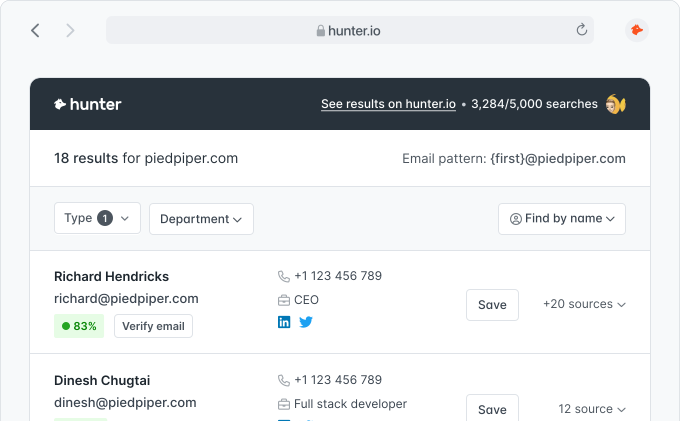
Getting someone's name wrong is the fastest way to undo a strong interview. Triple-check spelling before you send, especially for names you heard spoken rather than read. The same applies to job titles and company names. Small errors signal carelessness in an email that exists specifically to show you pay attention.

If you met with a panel member, each note needs to reference something specific to that conversation. Panel members compare notes. Identical emails to multiple interviewers get flagged immediately, and that's harder to recover from than a generic subject line.

Rewriting your resume in the body of the follow-up is the other move to avoid. If the interview went well, a lengthy restatement adds nothing. Keep the note brief and tied to what actually happened in the room.

Close with something direct: "I'll keep an eye out for next steps." It reads with more confidence than "Please let me know if you need anything else from me," which puts you in a passive waiting position.

Nous utilisons des cookies
Nous utilisons les cookies pour analyser comment le site web d'Hunter est utilisé et personnaliser votre expérience. En savoir plus