Whenever you want to show up uninvited, a simple email can open many doors for your career.
But emailing a stranger always feels hard, or even icky, if you haven’t tried it before.
Even worse, most prospects will not reply to your messages.
Trying to trick your prospects by using cheap gimmicks is not the answer, nor is it to just blast as many people as possible.
If you want to write an email that’s hard to ignore, you need to make it relevant, personalized, and useful.
This is easier said than done, but by the end of this guide, you will have the toolset to write emails that sound great and—most importantly—result in replies in your inbox.
You will learn how to write a subject line, email body, and a CTA that isn’t met with silence.
Let’s build a cold email from scratch, one piece at a time. By the end, you’ll have a complete email ready to send.
What is email outreach?
Email outreach is sending a message to someone with whom you have no prior relationship. “Cold email” is a synonymous term, but if done right, it doesn’t have to be cold, so we prefer “email outreach”.
Some people conflate outreach with spam, but the only thing they have in common is the unsolicited nature.
A good outreach email is researched, relevant, and written for a specific person or audience. Think of it as a tap on the shoulder at a business conference. It may well be uninvited, but if you have something useful to say and do it respectfully, it’s mutually beneficial.
When does email outreach work best?
Email outreach can be used for:
- Selling a product or a service: you’re sending an email to a buyer (or one of the people on the buying committee), and your end goal is to generate sales.
- Looking for a job: you’re contacting a recruiter or someone else at a business, and you’re hoping to get hired.
- Hiring someone for a job: you’re a recruiter, and you’re sending outreach emails to potential job candidates.
- Raising money, whether for a startup or a non-profit organization: you’re a founder or an early employee, and you’re contacting venture capital to get funding.
- User research: you’re looking to validate a business idea or learn more about your target audience and you’re sending email outreach to talk to the right people.
- Linkbuilding: you’re contacting people who manage websites so you can get your business mentioned for the SEO benefit.
- Influencer outreach: you have something to promote, and you’re sending emails to influencers to tap into their social following.
- Networking: you’re simply looking to make connections with the right people in your industry.
The list goes on. What you should say in your emails varies by use case, but the ground rules—relevance, personalization, and usefulness—remain the same.
How to write outreach emails (step by step)
To make this concrete, we’ll follow a running example—a freelance web designer named Alex who wants to land new clients among early-stage startups.
Before you start writing: Figure out what you can offer that’s relevant
Most people open a blank compose window and start typing. That’s where outreach often goes wrong, because it focuses on what you want to say and not what the recipient might be interested in. Before you write anything, you need to answer two questions:
- Who am I contacting?
- And what can I offer them that’s actually useful?
To solve this, take a piece of paper.
First, write down everything you know about your recipient's situation: what they're trying to accomplish, what frustrates them, what a win looks like for them.
Then, list what you offer.
Finally, draw lines between your strengths and their needs.
Here's what Alex's exercise looks like:
The founder's world: They just raised a seed round. They need to look credible to investors, hire talent, and convert website visitors into demo requests. But their site was thrown together during the MVP phase, and it shows.
What Alex offers: Startup-focused web redesigns that take two weeks, not two months. A portfolio full of before-and-after examples. Experience with the exact tools these founders already use.
Now Alex has three things to talk about: the founder's credibility problem, the speed of the solution, and proof that it works.
But knowing their situation isn't enough. You also need to think about what would make this person *want* to reply. People respond when your email does these things:
- Gives them something useful first. Share an insight, a resource, or an observation they can use whether or not they hire you. Alex might point out a specific problem on the founder's website—that's immediately useful.
- Shows that people like them are already doing this (like a case study). A quick mention of a similar startup that redesigned at the same stage makes the action feel normal rather than risky.
- Demonstrates you understand their world. Using their language, referencing their specific challenges, and showing you've done your homework signals that this email was written for them—not blasted to a list.
Step 1: Write a subject line that gets opens
Your subject line has one job: make the recipient pause rather than scroll past.
When people scan their inbox, most of it happens on autopilot. Your subject line needs to break that pattern and make someone think, “Wait, what’s this? It looks interesting.”
It follows that the worst you can do is look like everything else.
A few approaches that work:
- Curiosity gap: “Your site is costing you demos”
- Question: “Redesign before Series A?”
- Deep personalization: “Loved your Product Hunt launch”
One important rule: whatever your subject line promises, the rest of your email must deliver. A provocative subject line with a weak email creates distrust.
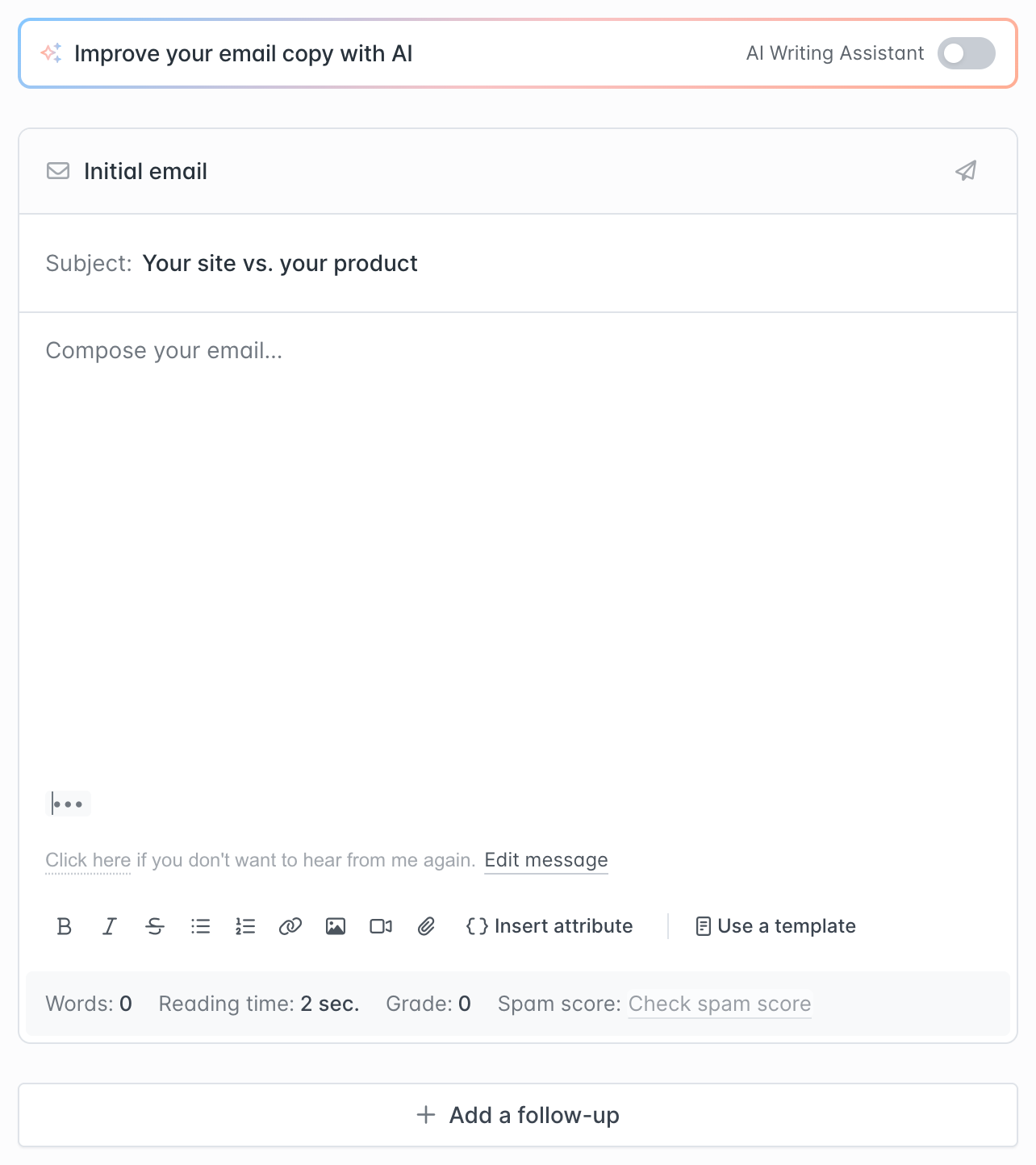
For Alex’s email, let’s go with: “Your site vs. your product”. It’s short, specific to the founder’s situation, and creates a curiosity gap—what’s the mismatch?
Step 2: Nail the opening line
The opening line tells the recipient why this email is for them. But "for them" doesn't mean you need to know their name, their company, or what they posted on LinkedIn last Tuesday.
If your targeting is right—if you've done Step 1 well—you can write an opening line that feels personal without referencing a single personal fact. The trick is specificity. Not specific to the person, but specific to their situation.
Compare these two opening lines:
Generic: "I help startups improve their online presence."
Specific: "Updating your marketing website is often the last priority when you're focused on the product—but from a user's perspective, it's the first touchpoint with your brand."
The second line doesn't mention the recipient's name, company, or Product Hunt launch. But if you send it to a founder whose site was clearly thrown together during the MVP phase, it lands—because it describes their exact reality. They read it and think, "that's me."
This is the baseline. A well-targeted, situation-specific opening line works. From here, you have two ways to go further:
Add a personal detail. Reference something specific to the recipient—a product launch, a blog post they wrote, a recent hire. This is stronger because it proves you've done your homework on this person, not just their category. For Alex: "Congrats on the Product Hunt launch last week—580 upvotes is no joke. I've been looking at Spectra's site since then, and the product looks way more impressive than the website suggests."
Add a trigger event. Reference something happening in their space or industry—a new regulation, a funding round, a seasonal shift. This sits between the two: it's timely and relevant without requiring individual research. "With seed-stage valuations tightening, most founders I talk to are trying to look more established than they are—and the website is usually the weakest link."
All three levels work. The choice depends on how many people you're emailing and how much time you can invest per email. If you're emailing 200 founders in a segment, a situation-specific opener is realistic and effective. If you're emailing five high-value prospects, the personal detail is worth the extra effort.
Here are a few more examples across use cases:
- Job seeking (situation-specific): "Scaling a sales team past 10 reps is where most onboarding playbooks break—everything that worked informally suddenly needs structure."
- Fundraising: "With the FDA fast-tracking digital therapeutics approvals, most founders in the space are fielding more investor interest than they can handle—but few have a deck that does the science justice."
- Linkbuilding: "Your guide on API rate limiting is one of the best I've seen—but the section on webhooks links to a page that 404s."
- User research: "Managing catering orders for large groups is one of those things every restaurant handles differently—and most POS systems just ignore it entirely."
- Recruiting: "The engineers who end up thriving at seed-stage companies almost never cite salary as the reason they applied—they cite the technical challenge. But most job posts at this stage read like a requirements checklist, not a pitch."
Alex's opening line: Congrats on the Product Hunt launch last week—580 upvotes is no joke. I've been looking at Spectra's site since then, and the product looks way more impressive than the website suggests.
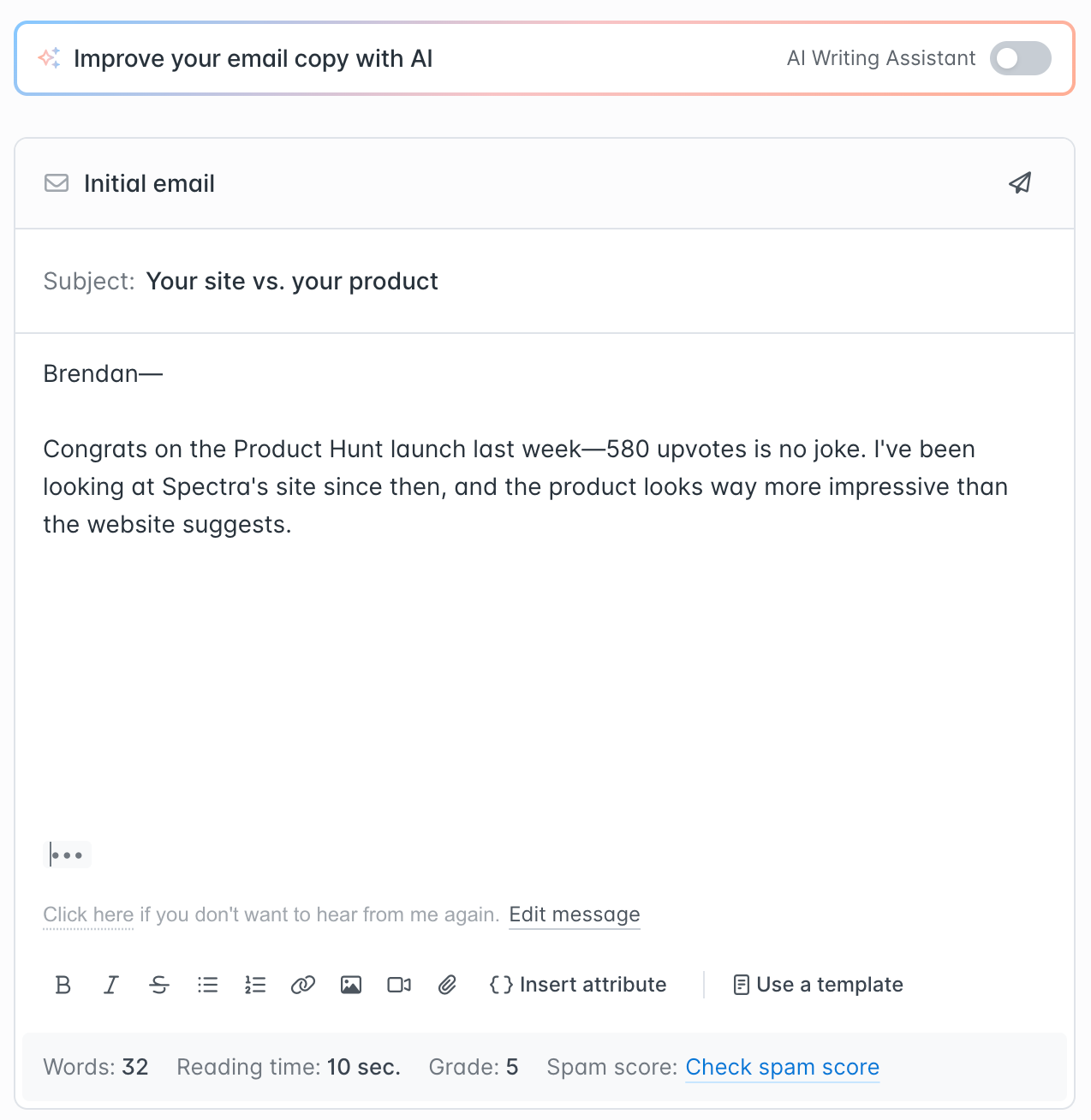
Alex is emailing one founder, so the personal detail is worth it. But the situation-specific version—"Updating your marketing website is often the last priority when you're focused on the product"—would work just as well in a campaign to 100 similar founders.
Step 3: Deliver value in the body
The body is where most outreach emails fall apart. People write about themselves—their company, their features, their awards. Flip it. Every sentence should be about the recipient's situation.
Here's a structure that works:
Name their problem. Start with something they'll recognize from their own experience. Not your product—their reality.
Show what it's costing them. Connect the problem to something they care about—lost revenue, wasted time, missed opportunities. Be specific.
Bridge to what you offer. One sentence. Focused on the outcome, not the feature.
Add proof. A quick result, a name they'd recognize, a number. One sentence—don't turn the email into a case study. Mentioning someone in a similar position who got a specific result makes your claim feel concrete rather than hypothetical.
Hunter's data shows two word count sweet spots for email bodies: 61–80 words and 181–200 words. Short works when the pain is obvious; longer works when you need to educate.
Alex's body:
That gap between product and website is more common than you'd think at the seed stage—but it costs you. Investors check your site before the pitch. Candidates google you before applying. And demo requests drop when the site doesn't match the product quality.
I redesign startup websites in two weeks, not two months. Here's a recent before-and-after for a company at a similar stage: {{link}}.
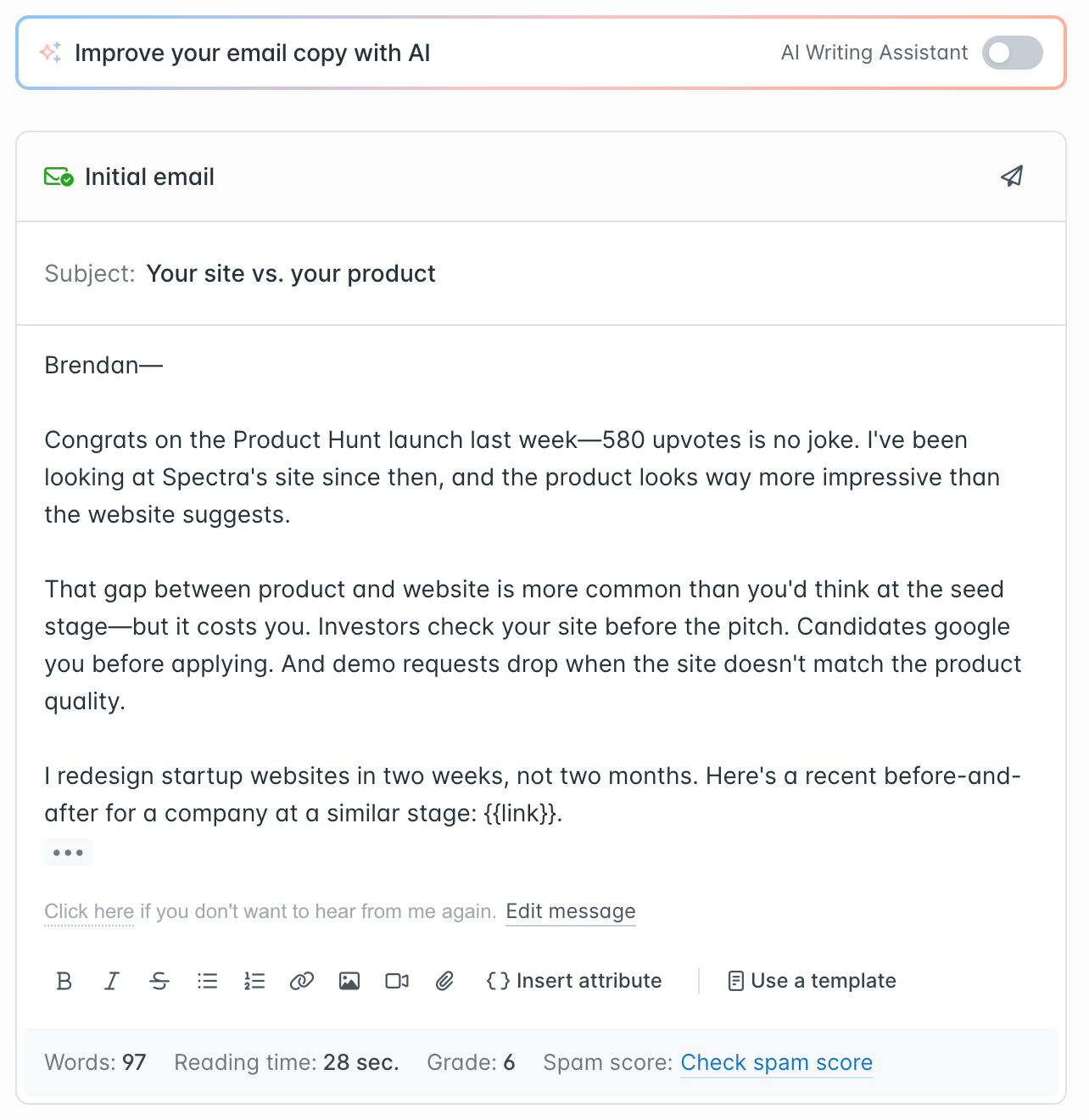
Notice: Alex never says "I'm a freelance designer with 8 years of experience." Every sentence is about the founder's world. The proof is a concrete example from a similar company—not a vague claim about "helping startups succeed."
The same structure works regardless of why you're emailing. Here's how the body changes by use case:
Job seeking: "I noticed you're scaling the sales team fast—onboarding that many reps at once usually means coaching time gets squeezed. I built the onboarding playbook at my last company that cut ramp time from 6 months to 3."
Fundraising: "Most pre-seed founders I talk to spend 60% of their fundraise chasing warm intros that never come. I ran the Techstars accelerator program in Austin for three years—happy to share what I've seen work for founders at your stage, no strings attached."
Linkbuilding: "Your guide on API rate limiting is genuinely one of the best resources out there. I noticed the webhook section links to a deprecated page—I just published an updated walkthrough that could be a good replacement."
Recruiting: "The engineers I've placed at seed-stage companies all say the same thing—they didn't apply because of the salary. They applied because the technical challenge was clear from the job post. Right now, yours reads more like a requirements checklist than a pitch."
User research: "I'm building a tool for restaurant owners to manage catering orders—and I keep hearing conflicting things about how they handle large-group requests today. Would love to learn how it actually works at a place like yours."
Step 4: End with a clear call-to-action
One CTA per email.
Make it low-friction—ask for a reply, not a commitment.
Match the CTA to the situation:
- Sales (pain is obvious): "Would it make sense to chat for 15 minutes this week?"
- Sales (not sure about fit): "Is this something you're thinking about right now?"
- Job seeking: "Would you be open to a quick coffee chat about the role?"
- Fundraising: "Would it help if I sent over a 2-page overview of what we're building?"
- User research: "Would you have 20 minutes this week to walk me through how you handle this?"
- Linkbuilding: "Happy to send over the updated resource if you think it'd be a good fit."
- Recruiting: "Mind if I send over a candidate profile that might be a match?"
- Networking: "I'd love to hear how you approached {{specific thing}}—any chance you'd be up for a quick call?"
- Referral (any use case): "If this isn't your area, who should I reach out to?"
Avoid asking for too much. "Let me know if you'd like to schedule a 30-minute demo to walk through our features and pricing" is too formal, too product-focused, and asks for too big a commitment from a stranger.
Alex's CTA: Worth a 15-min call to see if this'd make sense for Spectra?
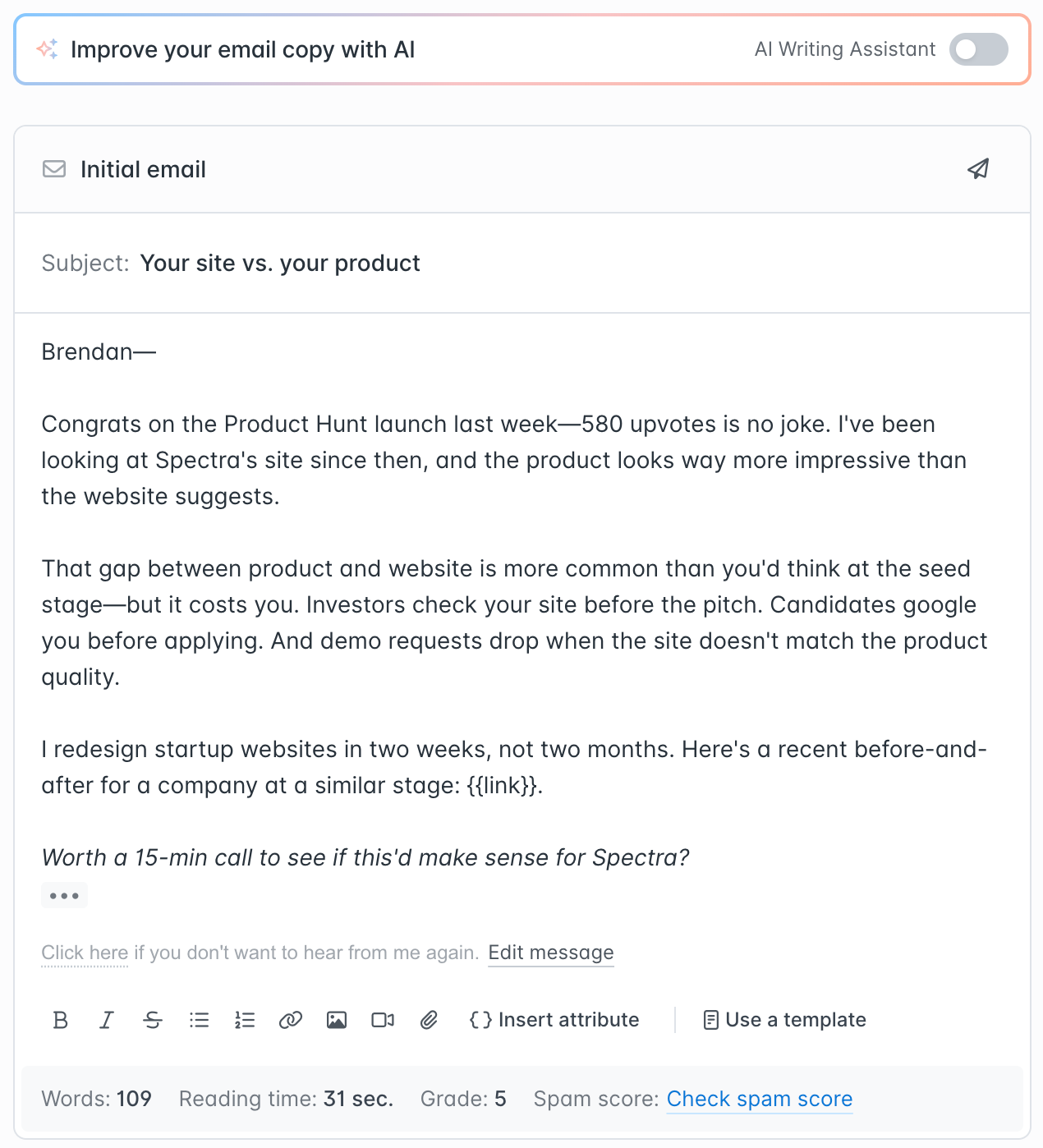
Short, specific to the recipient's company, and easy to say yes to.
Step 5: Optimize your signature
Keep it clean: name, title, company, one link. Avoid image-heavy signatures—they can trigger spam filters. A professional signature builds credibility when the recipient doesn't know you yet.
If you’re using an outreach platform like Hunter, your signature is likely configured on the ESP side (for example, Google Workspace).
Putting it all together
Here's Alex's complete outreach email:
Hi Jordan,
Congrats on the Product Hunt launch last week—580 upvotes is no joke.
I've been looking at Spectra's site since then, and the product looks way more impressive than the website suggests. That gap between product and website is more common than you'd think at the seed stage—but it costs you. Investors check your site before the pitch. Candidates google you before applying. And demo requests drop when the site doesn't match the product quality.
I redesign startup websites in two weeks, not two months. Here's a recent before-and-after for a company at a similar stage: {{link}}.
Worth a 15-min call to see if this'd make sense for Spectra?
Alex Garcia
Freelance Web Designer
Every sentence either establishes relevance or delivers value. The opening references a specific event. The body is about the founder's world, not Alex's resume. The proof is concrete. The CTA is easy to answer.
Scaling personalization when you're emailing many people
The email above was written for one person. But what if you need to send a version of this to 50 founders in a similar situation?
The core email—the body, the structure, the argument—stays the same for everyone in that segment. What changes is the personal detail: the opening line and a few specific references.
There are three levels of personalization, and you don't need all three:
Custom attributes. Swap in {{firstName}}, {{companyName}}, and {{link}} using your email outreach sequencer. This is table stakes—it adds variance but still reads like a template.
AI-assisted personalization. Feed prospect data (LinkedIn activity, recent funding, job postings) into an AI email writer and let it rewrite the opening line. Always review by hand—thin data produces generic lines, and skipping review risks sending hallucinated facts.
Research-based personalization. Look up something specific—a blog post they wrote, a product launch, a conference talk—and reference it in the opening line. This is the highest-quality personalization and the hardest to scale.
The data makes the case: emails with no personalization get a 3.6% reply rate; emails with two custom attributes hit 5.6%—a 56% lift (State of Email Outreach). But 69% of decision-makers say they're bothered by emails that lack a human touch. The sweet spot is automation plus human review.
One rule: personalize with professional context (company news, public work, role), never with personal data just because it's available. If it would feel creepy in the first 30 seconds of a cold call, it's creepy in an email. For more, see our guide on personalizing your emails.
How to follow up on an outreach email
Single-email campaigns get 3.3% total replies; three-email sequences get 6.8%—over double (State of Email Outreach).
The most important rule to remember when following up: a follow-up is not a reminder. If the recipient didn't respond to your first argument, repeating it louder won't help. Say something different.
Each email can present a different reason to care. Each CTA can get progressively easier to reply to. If you reduce the ask in a follow-up—say, offering a 2-minute Loom walkthrough instead of a call—you visibly make a concession, which makes the recipient more inclined to meet you halfway.
Space follow-ups 3–5 business days apart. Send them in the same thread by default—the recipient sees a conversation, not three interruptions. Break the thread only for long enterprise sequences spanning months, re-engagement after a long gap, or a complete topic shift.
Even when threading, each email should work standalone. Someone who only reads Email 3 should still understand what you're offering. For more on structuring sequences, see our sales email outreach guide and follow-up email templates.
Best practices for sending email outreach
A few operational levers that make a measurable difference, all from Hunter's State of Email Outreach (31M emails):
Send from a custom domain. 5.2% reply rate vs. 2.5% for freemail—a 108% difference. This is the single biggest infrastructure lever. Alex should be sending from alex@alexgarcia.design, not alex.garcia.designs@gmail.com.
Consider disabling open tracking. Emails without tracking pixels see a 7.4% reply rate vs. 4.4% with tracking (+68%). Tracking pixels can trigger spam filters.
Cap daily volume. 20–49 emails per day hits a 5.7% reply rate, 27% above average. More isn't better. Hunter's data shows sequences sent to 21–50 recipients average a 6.2% reply rate vs. 2.4% for 500+ recipients.
Verify email addresses before sending. The average bounce rate is 3.6%. High bounces damage your sender reputation and make future emails more likely to land in spam.
For more on optimizing your technical stack, read our guide to email deliverability.
Email outreach writing FAQ
How long should an outreach email be? There's no specific word count that clearly performs best; it depends on the use case. Shorter works for obvious pains; longer works when you need to educate.
What is a good email outreach response rate? The overall average is 4.5% across 31 million emails we analyzed in the State of Email Outreach report. It varies by use case: sales averages 3%, marketing 6.2%, digital PR/link building 13%, and headhunting 7.5%.
Is email outreach legal? Yes, with rules. In the US, CAN-SPAM requires an opt-out mechanism and honest headers. In the EU, GDPR allows outreach email under "legitimate interest" but requires a lawful basis. In Canada, CASL is stricter—you need implied or express consent.
How many follow-ups should I send? Two to three. Three-email sequences more than double reply rates compared to single emails. Returns diminish after that.
Should I use AI to write outreach emails? 69% of decision-makers say they're bothered by emails that lack a human touch, and manually edited emails outperform fully automated ones by 18%. If you use AI to write email outreach, make sure your emails still feel personal.