SEO is central to Hunter's success, and in this competitive niche, link building has enabled us to grow and maintain our organic traffic over the years.
Around 80% of the links we build at Hunter come from relationships—not one-off asks. The remaining 20% comes from specific tactics such as link insertions, listicle placements, guest blogging and unlinked-mention outreach. But even those tend to work better when there's a relationship behind them.
This guide covers the exact process I use to run link building outreach: how I choose which strategies to prioritize, where I find prospects, how I segment and message to them, and what conversion rates to expect.
I'll share email templates for different scenarios, advice on following up, and the lessons that took years of backlink outreach to learn.
If you're looking for a broader overview of cold email outreach, we have a separate guide. This one is specifically about building backlinks.
TL;DR: Link Building Outreach
Link building outreach helps grow your website’s online visibility by securing backlinks from other relevant domains, using email and other outbound channels to reach them.
Link building outreach at Hunter is a relationship-first motion, not a numbers game. 80% of our links come from partnerships, with the remaining 20% coming from specific tactics.
Top strategies (prioritized):
- Editorial links (Link insertions): The "holy grail." Insert your link into existing, high-traffic, relevant articles.
- Listicle outreach: Get placement in "best tools" or "top solutions" articles for bottom-of-funnel traffic and LLM visibility.
- Guest posts: Build authority and secure writing samples, which lead to higher-tier placements and partner links.
- Unlinked brand mentions: Pursue opportunistically, but not as a core strategy.
What we skip: Broken link building and the Skyscraper technique (low yield, overused).
The funnel:
- 1.3% Prospect-to-Backlink conversion rate (for every 1,000 prospects emailed, ~13 links are secured).
- 66% of replies come from follow-ups. Always use a 3-email sequence (initial pitch, reframe, breakup).
Key takeaways for success:
- Relationships are everything: Focus on offering value (network access, introductions, guest post spots) before asking for a link.
- Segmentation is critical: Tailor your message based on the recipient's role (SEO/Content Manager vs. CEO) and the prospect's DR/domain type.
- Be direct and value-first: Keep emails short (3–5 sentences) and make the offer clear in the subject line or preview.
- Use LinkedIn for compounding benefits: It bypasses deliverability issues and leverages social proof.
- Don't obsess over DR (Domain Rating): Prioritize websites that are real businesses with real traffic and genuinely useful content.
What is link building outreach?
Link building outreach involves using email, LinkedIn, and other outbound channels to acquire external links to your website and online mentions of your business. Both links and brand mentions positively affect your online visibility: not just in Google Search results, but also in LLM responses/answer engines.
Even though email is a key channel for link builders, link building outreach is closer to partnership development than cold emailing—even though most guides treat it as the latter.
The usual framing is transactional: contact website owners, pitch a link, move on. Treat it as a numbers game. Blast enough emails, and some percentage will say yes.
This approach may work, but it caps your potential.
The links that actually move rankings—editorial placements on relevant, high-traffic pages—come from people who know you, trust your brand, and see mutual value in working together.
That's why I think of outreach link building as two activities running in parallel: relationship building (the long game that compounds over time) and tactical outreach (specific asks for specific link types). Both matter, but the first is what separates sustainable programs from ones that plateau.
Why link building outreach is about relationships
I maintain active partnerships with 20 to 50 people at any given time. This means we're in regular contact—sharing link opportunities, introducing each other to new partners, collaborating on guest posts. I even ask them for feedback on my sequences and brainstorm solutions when campaigns are underperforming.
Beyond that, there's a broader community of roughly 300 people in our partner Slack channel, though not all of them are active.
This network is the single most valuable asset in our link building program. Here's why.
When I reach out to a new prospect, I lead with access to this network. The pitch isn't "can I get a link?"—it's "we know the challenges of link building, so why don't we help each other?" I can offer introductions to partners who are relevant to their niche, invite them to a community of SaaS companies doing active link building, or add them to an upcoming guest post.
How to build your link-building network if you're starting from zero
If you are new to link building, you likely won't have a network of link builders (yet).
The easiest way to build from scratch is to pick a topical niche, write a few guest posts and to look for meaningful relationships with others in your niche. Guest posts connect you with editors and build credibility that helps reach out to others with something specific.
LinkedIn is the best place to start. Use guest blogging in combination with looking for meaningful partners to create writing samples, build a small portfolio, and lay the foundations of a network.
One tactic to get more juice out of your blog posts is to offer placement to your partners. That way, a single blog post doesn't just earn you one backlink, but also builds reciprocity with your network of fellow link builders.
Begin with five strong partners and expand slowly. That's not a shortcut—finding five people who reliably collaborate takes real effort. But five active partners will outperform fifty who joined a Slack channel and never logged in again.
To start these conversations, browse our partnership email templates.
Link building strategies worth your time (ranked)
There are many ways to obtain links for your website.
The basic premise is:
- You find a website that matches your criteria (topical relevance to your business, healthy traffic, and link profile).
- You identify the best person to contact (someone who can directly manage content on the website).
- You reach out via email—and sometimes add more channels to the mix.
But there are many ways to find relevant websites, and many strategies to leverage.
Not all of these strategies deserve equal effort. Here's how I rank them by impact, based on years of running outreach at scale.
Editorial links from high-quality websites (link insertions)
This is the holy grail of link building, and it's the strategy I prioritize above everything else.
An editorial link means getting your link inserted into an article. But not just any article.
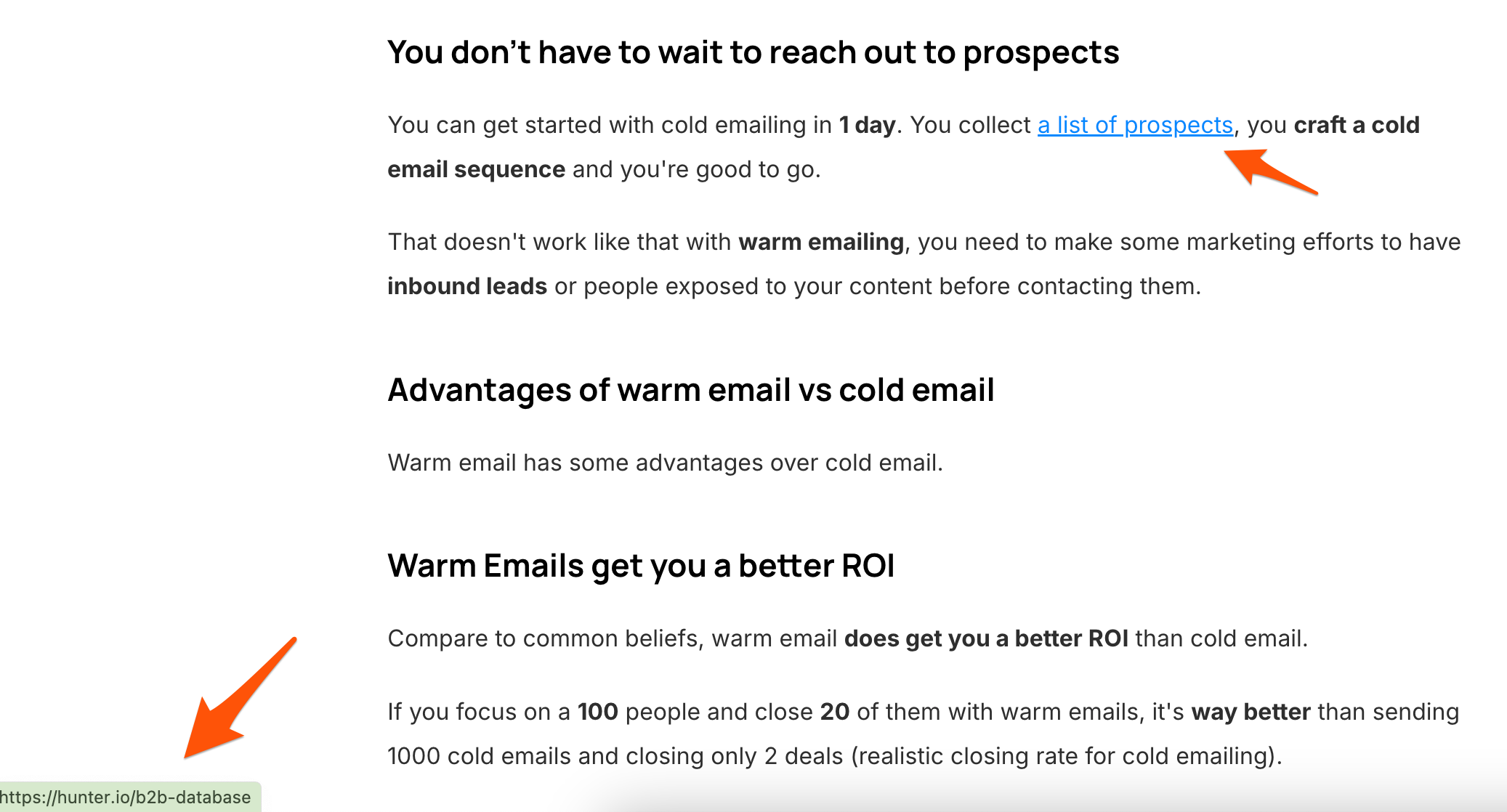
What's key is that you find websites highly relevant to your own website. So if you're building links for a CRM product, you need other websites that talk about sales, recruitment, customer management—not Christmas decorations or Formula 1.
Then, in the ideal scenario, the websites you target should also:
- Have a healthy link profile (avoid websites that are overused for link building—a telltale sign is pages with dozens, if not hundreds, of editorial links),
- Already have some traffic from Google, and
- Have a high Domain Rating.
A single editorial link from a relevant, healthy website can be worth 10+ regular backlinks, because what matters isn't just the domain—it's the specific page. A link from a DR 60 article that ranks on page one for a competitive term and gets thousands of monthly visitors sends far more value than a link from a high-DR domain's blog post that nobody reads.
Editorial link building is also scalable. Once you find articles where your product or content fits naturally, the ask is straightforward.
Listicle outreach
Listicle outreach targets listicles where your product or company could appear. The goal is to secure placement and fair coverage in a list of competing solutions.
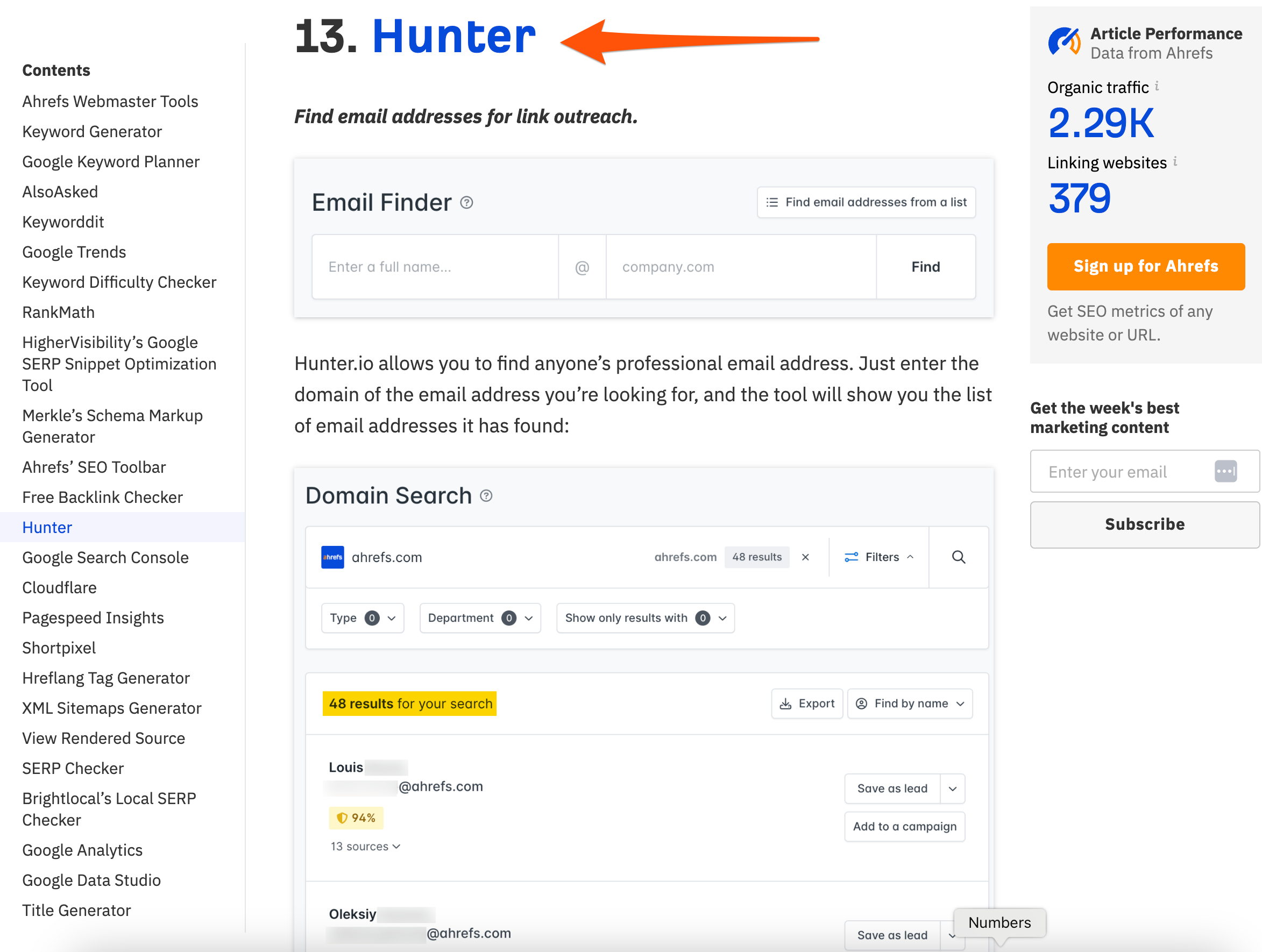
Listicle placements serve double duty in 2026: they help with traditional SERP rankings and with LLM visibility. If your product appears in "best X tools" or "top Y solutions" articles, AI models that crawl and cite these pages may also reference your brand.
A key advantage of achieving placements in listicles is the ability to influence the narrative. Typically, when an editor agrees to feature your product, they will request details about its capabilities, pricing, plans, and other information relevant to readers.
While this doesn't allow for exaggeration or misleading claims (editors usually ensure a neutral presentation), it does provide a valuable chance to accurately describe your features, including the promotion of any new ones.
This control is vital because when others, especially competitors, place your product in their listicles, they often actually mislead their readers to downplay your strengths, or even openly lie about your pricing or lacking features.
Listicles also capture bottom-of-funnel traffic. Visitors reading "best email outreach tools" are comparing options and may convert. That makes listicle backlinks valuable beyond just their SEO impact.
Guest post outreach
Guest posting is when you reach out to websites with an article pitch. You offer free content–they offer placement for your link.
Guest posting takes more effort than the other strategies: you need a topic pitch, an outline, a finished draft, and patience while the editor reviews and publishes. Communication delays are real—a single guest post can take weeks from pitch to publication.
But it's a must-have. Guest posts establish you as an authority in your niche, and each one creates two to four link building opportunities. You can include your own backlink, add links for partners (which strengthens your relationships), and use the published piece as a sample when pitching higher-authority sites.
The progression looks like this:
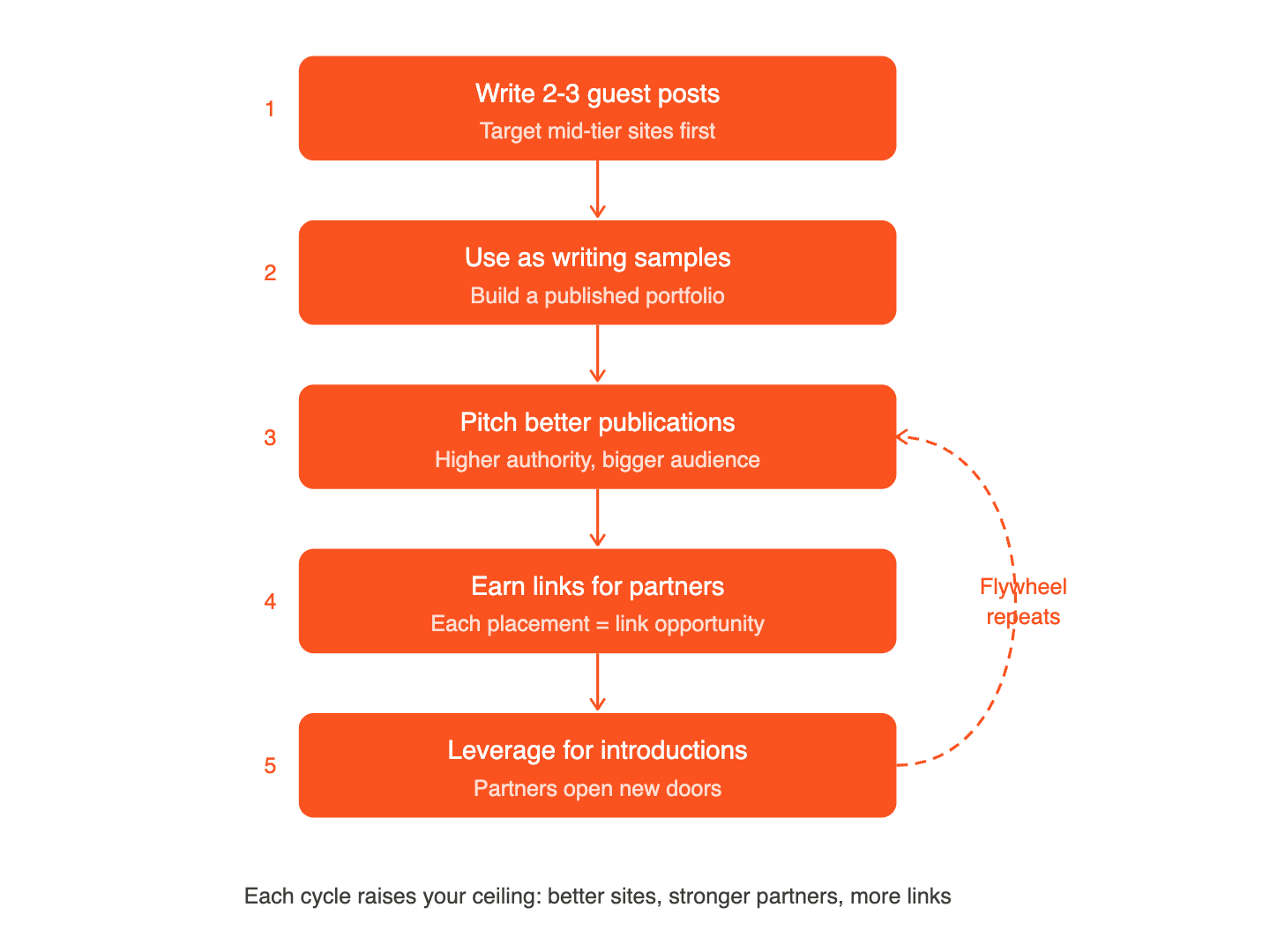
I treat guest posting as link building maintenance work. It's not the most effective at face value, but it helps you build long-term relationships and topical authority.
For pitch templates, see our guest post email templates.
Unlinked brand mentions
Unlinked mentions are when your brand or product is covered on other websites, but without an actual <a href> link.
If someone already mentions your brand in their content without linking to you, asking for a link is one of the easiest outreach wins.
But... I don't prioritize it.
An unlinked brand mention is already powerful for brand signals—adding a link is incrementally better, not dramatically better.
Pursue these opportunistically, not as a core strategy. We run recurring campaigns (think twice a year) to cover all unlinked mentions in regular sweeps.
What we skip (and why)
Broken link building. In theory, you find broken links on relevant pages and offer your content as a replacement. In practice, any website worth getting a link from is already monitoring and fixing their broken links. The yield is too low to justify the prospecting time. If you really want to pursue this strategy, try to cover as many broken links as possible with one recurring campaign and move on to other methods.
The skyscraper technique. The premise: you find an article that could naturally mention your product, and you reach out with a suggestion that your link can make the current article better. This worked years ago. Today, it's overused and underperforming. Most people I know in the space have moved on.
I'd rather be honest about what doesn't work than pad this guide with strategies that sound good but waste your time.
How to find the right websites
Using Ahrefs Content Explorer
Ahrefs is my primary prospecting tool because of its filtering capabilities. Content Explorer lets you search for pages covering specific topics and then filter by organic traffic, Domain Rating, language, publication date, and more.
The workflow: search for your target topic, filter for pages with real traffic (I typically set a minimum of 500 monthly visits), exclude domains you've already contacted, and export the results. This gives you a list of pages—not just domains—that are actually relevant and have an audience.
Competitor backlink analysis
Open a competitor's backlink profile in Ahrefs and look specifically for listicles and articles where they're mentioned. Filter for pages where your competitor has a link but your brand doesn't appear. These are pre-qualified opportunities—the site already links out to products like yours, so your outreach has a higher chance of landing.
Google operators (budget option)
If you don't have access to Ahrefs, Google search operators can get you started. Try queries like:
- "best [your category] tools" -site:yourdomain.com
- "top [your category]" inurl:blog
- intitle:"[competitor name]" "[your topic]"
This is slower and less precise than Ahrefs, but it costs nothing. Once you have a list of domains, use Hunter's Domain Search to find the right contacts.
What to offer (and how to keep it fresh)
The biggest ongoing challenge in link building isn't finding prospects—it's having something compelling to offer them.
Here's the problem: when a particular offer works well, everyone in the industry copies it. Within months, prospects start hearing the same pitch from dozens of people, and response rates drop. You need to constantly diversify.
Offers that work right now:
- Partner network or community access. If you have a Slack channel, Discord community, or regular partner calls, this is one of the strongest offers because it's ongoing value, not a one-time transaction. If someone isn't interested in connecting with a network of link building partners, they're probably not the right person to build a relationship with. Anyone who's actively doing link building will see the value in tapping into a partner network. That's a useful qualifying signal.
- Introductions to relevant contacts. "I can introduce you to [partner] who's looking for exactly the type of collaboration you do." This is highly personalized and hard to replicate at scale—which is exactly why it works.
- Guest post spots. Offering to feature someone in an article you're writing gives them exposure and a backlink without any effort on their part.
- LinkedIn shout-outs or tool reviews. If you have a strong LinkedIn presence, a public endorsement of someone's tool carries real value. This is especially effective with SaaS founders.
- ABC exchanges. Site A links to Site B, Site B links to Site C, Site C links to Site A. This avoids the "reciprocal link" issue that Google may devalue. It's one of the most effective structures, but the "B" domains—the ones in the middle—get overused quickly. You need a constant supply of fresh domains to make this sustainable.
The meta-lesson: your offer needs to evolve. What works this quarter may not work next quarter. Stay close to your partners, share what's working, and be willing to experiment.
Finding the right contact person
Who has the power to add a link?
The single most important question when choosing who to contact: can this person adjust the content on their own?
<recording Domain Search—shows browsing job titles>
Here's the priority order I follow:
- SEO specialist or SEO manager—they understand the value of link building instantly and usually have direct access to the CMS.
- Content manager or editor—they own the editorial calendar and can approve content changes.
- Head of marketing—broader authority, though they may delegate to someone on their team.
- Founder or CEO—only if the company is small enough that they handle content directly.
- Generic email (info@, contact@)—last resort, but sometimes it's all you have.
Adjusting your message by role
This is something most link building guides skip entirely, but it's critical. An SEO specialist and a CEO (or founder) need fundamentally different emails.
For SEOs and content managers: Be direct. They know what link building is. They know what Domain Rating means. Lead with your offer and make it easy for them to evaluate the opportunity. "I noticed your article on [topic] ranks well—I think [your resource] would be a relevant addition for readers looking for [specific angle]."
For founders and CEOs: Connect the dots to business outcomes. They don't think in terms of backlinks—they think in terms of revenue, market positioning, and growth. Frame it as: "A partnership could help your [product page] rank higher for [keyword], which currently gets X monthly searches. That's potential traffic you're leaving on the table."
Segmenting your prospect list
Most outreach guides treat all prospects the same. That's a mistake. I segment every prospect list along three axes, and each one changes how I write the email.
By SEO metrics (DR, traffic, page authority)
Domain Rating determines how much effort each prospect gets.
DR under 40: These sites are generally easier to get links from. A well-written sequence email with a clear offer is often enough. Personalization can be lighter than for high-DR sites—mention their specific article and what you'd add—but you still need to read the page and make sure your pitch actually fits. "Lighter" doesn't mean "generic."
DR 40–70: The sweet spot. These sites have real authority, real traffic, and real editorial standards. Personalization matters here—reference specific content they've published, explain why your resource fits their audience, and make the value proposition clear.
DR 70+ (think HubSpot, Ahrefs, major publications): These require manual research and custom messaging. I often send these from my personal email rather than through a sequence. The approach is closer to pitching an editor than running outreach—you need a specific angle, a compelling reason they should care, and ideally a warm introduction.
By domain type (SaaS, agency, blog)
SaaS companies: Lead with community and network access. Our Slack channel, for example, is exclusively for SaaS companies doing active link building. That exclusivity makes the offer more compelling.
Agencies: Business development reps and salespeople are often the best points of contact. They manage multiple clients and naturally think in terms of partnerships. SaaS link building agencies are particularly valuable—partnering with one gives you access to their entire client roster.
Blogs and media sites: Lead with content exchange value. Offer guest post contributions, expert quotes for their articles, or data from your own research that they can cite.
Crafting link building emails that get replies
Link building email outreach is deceptively hard to write well. You need to be short enough to read in 10 seconds, clear enough that your purpose is obvious, and compelling enough that someone takes action—all while avoiding spam trigger words. Here's how we approach it.
Subject lines
If you work at a recognizable brand, use it. "Hunter × [Company] partnership" works better than a generic subject line because it immediately signals legitimacy and mutual benefit.
The harder part: avoiding spam filters. Words like "backlinks," "link exchange," "SEO partnership," and "link building" can trigger filters. You need to communicate your purpose without using the obvious terminology. Focus on "content collaboration," "partnership," or simply reference the specific article you're writing about.
For more ideas, check our list of effective cold email subject lines.
Email body: short, value-first, transparent
You're competing with emails that ask for a link exchange without offering any additional value.
So your best bet if you want to stand out is to focus on what you can offer beyond just another link.
Keep your outreach emails short. Three to five sentences is enough. Offer value in the first line—don't open with a compliment about their website and bury the ask in paragraph three.
The email preview (the first ~90 characters that show in the inbox) should already make your purpose clear. If a recipient can't tell what you want from the preview alone, the email is too long or too indirect.
Here's the structure that works for us:
Template: editorial link outreach (to an SEO/content manager)
Hi [Name],
I enjoyed [specific relevant point] in your article about [topic]. [ask a specific question/observation based on the point]?
I think [your resource/tool] would be a useful addition for readers looking for [specific angle]. It [one sentence on what it does and why it's relevant].
Would you be open to adding it? Happy to return the favor—we have several ranking articles where a mention of [their product] would fit naturally.
Best, [Your name]
Template: relationship-building outreach (to a SaaS company)
Hi [Name],
I run link building at [Your company] and noticed [their domain] is actively building links in the [niche] space.
We work with a network of [X] SaaS companies that collaborate on link building—sharing opportunities, making introductions, and helping each other get placements. I think [their company] would be a great fit.
Would you be open to a quick chat about how we could help each other?
Best, [Your name]
Template: outreach to a CEO/founder
Hi [Name],
I've been following [their company]'s growth in the [niche] space. Your [specific product/feature] stands out.
We're working with several companies in [industry] on content partnerships that help improve organic visibility for competitive terms. One of our partners saw a [X]% increase in organic traffic to their [page type] after a few well-placed brand mention.
I think there's an opportunity for [their company] too. Would it make sense to connect?
Best, [Your name]
Template: listicle inclusion request
Hi [Name],
I love how detailed your [article about] round-up is. [Pick something specific from the roundup and connect it to the tool you are pitching].
[One to two sentences: what your product does and why it fits the list. Be specific about the category match.]
I can provide a short blurb, screenshots, and any details you'd need to add it. Let me know if you're interested.
Best, [Your name]
Template: breakup follow-up (final email in sequence)\
Hi [Name],
I understand this might not be the right time. Totally fine—no hard feelings.
If things change down the road, feel free to reach out anytime. Alternatively, if there's someone else on your team who handles content partnerships, I'd appreciate an intro.
Either way, I'll check back in next quarter in case the timing works better then.
Best, [Your name]
For more templates across different scenarios, browse our full library of link building email templates.
The follow-up sequence that drives 66% of replies
This is one of the most important numbers in our outreach program: 66% of our replies come from follow-up emails, not the initial outreach. If you send one email and move on, you're leaving most of your results on the table.
We use a 3-email sequence:
- Initial email—the value-first pitch described above. Clear, short, specific.
- Follow-up #1 (3–5 days later)—reframe the original offer and add a different value proposition. If the first email led with network access, this one might mention a guest post opportunity or a specific article where you could feature them. Never send a generic "just checking in" or "bumping this to the top of your inbox." Those add nothing.
- Follow-up #2 / breakup email (5–7 days after that)—acknowledge that the timing might not be right. Offer to reconnect next quarter, add another element of value, or ask for an introduction to the right person on their team. This email often gets the highest response rate because it removes pressure.
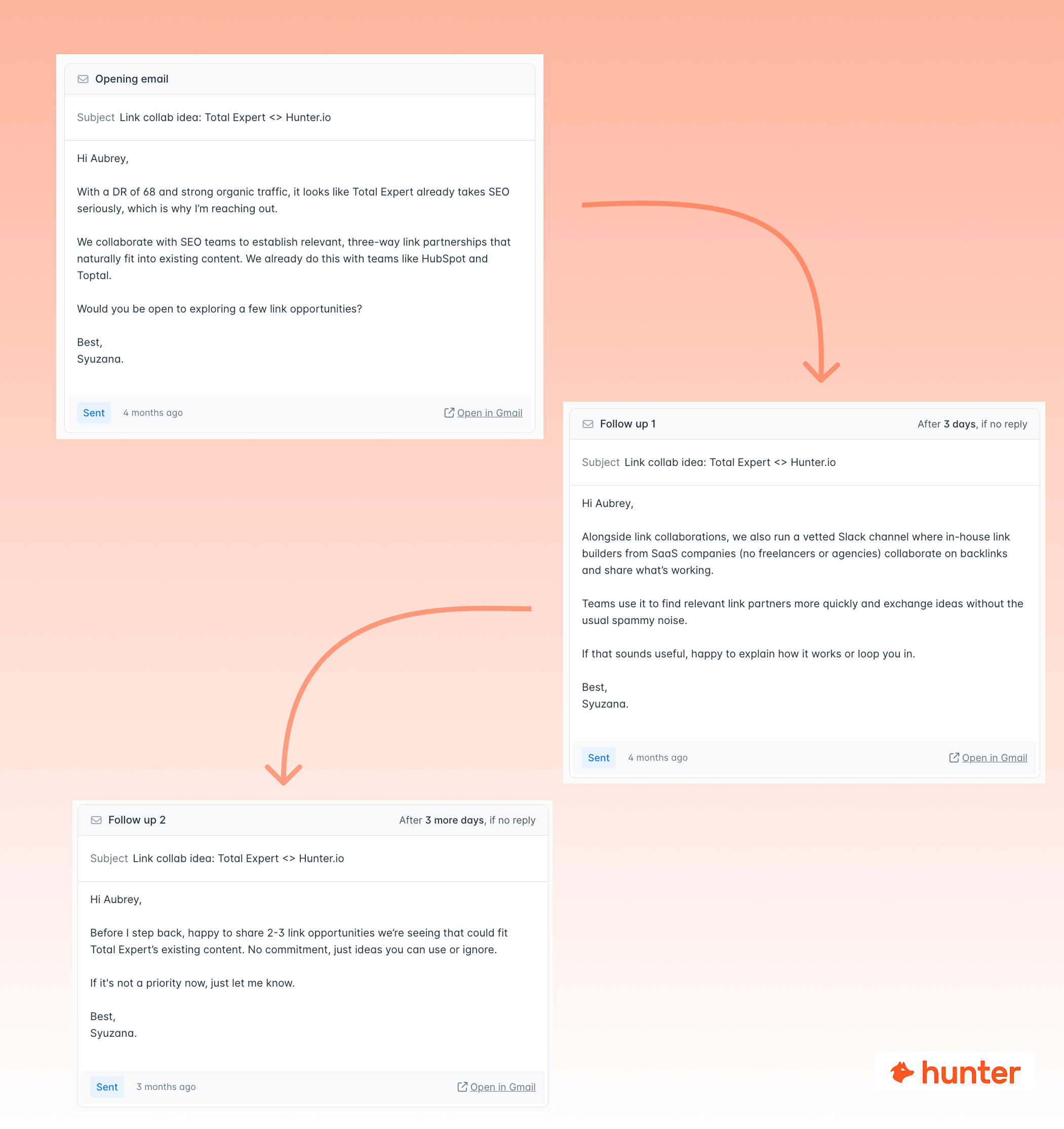
You can automate this sequence using cold email software like Hunter Sequences.
Deliverability and LinkedIn as a backup channel
Avoiding the spam folder
Deliverability is the invisible killer of link building outreach. You can write the perfect email to the perfect prospect, and it won't matter if it lands in spam.
A few rules that help: avoid link building trigger words in your subject line and body ("backlinks," "link exchange," "SEO collaboration" are common offenders). Keep emails short—long emails with multiple links look like marketing blasts to spam filters. Warm up new sending domains before running high-volume sequences. And monitor your sender reputation regularly.
Deliverability is a deep topic on its own. For the full picture, read our guide to email deliverability.
Why LinkedIn is becoming essential
LinkedIn has become a genuinely important complementary channel for link building outreach for two reasons.
First, it sidesteps deliverability issues entirely. Your message lands in their LinkedIn inbox regardless of spam filters, domain reputation, or email authentication issues.
Second, a strong LinkedIn profile unlocks additional offers. You can propose a shout-out or review of their tool on your feed. You can engage with their content before reaching out via email, so your name is already familiar. If you have a large following, a public mention from you carries real weight—especially for SaaS companies that care about social proof.
I don't see LinkedIn replacing email for link building outreach. But using both channels together consistently produces better reply rates than either channel alone.
Expected results: the link building outreach funnel
Most link building guides don't share real numbers. Here are ours.
For every 1,000 prospects we email:
- ~50 reply (5% reply rate)
- Of those, ~25 are positive (50% positive rate)
- Of those, ~13 result in a published backlink (roughly 50% close rate)
That's a 1.3% prospect-to-backlink conversion rate. It's not glamorous, but it's honest, and having spent years in the industry, I know this is a good conversion rate given the scale of our link building operation.
If your reply rate drops below 5%, something is wrong. Check your deliverability first (are emails actually reaching inboxes?), then your targeting (are you reaching out to people who actually do link building?), then your offer (is it compelling enough to warrant a reply?).
When we tracked open rates (we've stopped in order to optimize deliverability), anything above 30% was decent. Below that usually indicates subject line or deliverability problems.
To plan your campaigns around these numbers, our outreach calculator lets you model expected results based on your list size and conversion assumptions. And for a real-world example, see how Goldie Agency built 300 backlinks using Hunter Sequences—taking their Domain Rating from 31 to 41 in under ten months.
Best practices we've learned the hard way
Don't obsess over metrics. Domain Rating, organic traffic, and referring domain counts can all be manipulated. I've seen sites with a DR of 70+ that are essentially link farms with no real audience. After reviewing a few hundred domains, you start recognizing the patterns—thin content, no real product, pages stuffed with outbound links. Until you develop that instinct, ask yourself: Does this site look like a real business with real readers? Would I be comfortable seeing my brand linked from this page?
Quality over quantity. One link from a page that ranks well and is genuinely relevant to your product is worth more than ten links from low-authority domains that exist primarily for link building. Target pages that already rank for meaningful keywords—that's where the link equity actually flows.
Build relationships, not just links. Put your partners in a CRM. Check in periodically—not just when you need something. "Are you seeing lower response rates this year?" or "Have you found any new strategies that are working?" People are surprisingly willing to share. The partners I've worked with for years are the ones who consistently deliver the best results.
Start small. Five partners who actively collaborate and reliably follow through are more valuable than fifty who joined your Slack channel and never logged in again. Scale when the foundation is solid, not before.
For more hard-won lessons on running outreach at scale, read about the 5 things we learned after sending 12,000 cold emails.
Frequently asked questions
What reply rate should I aim for in link building outreach?
Anything above 5% is acceptable. Below that, investigate your deliverability (are emails reaching inboxes?) and your targeting (are these people actually involved in link building?). For context, Hunter's State of Cold Email report found that the average cold email sequence reply rate across all use cases is 4.5%.
How many follow-up emails should I send?
Two follow-ups after the initial email. The second follow-up should be a "breakup" email that removes pressure and gives the prospect an easy out. We've found that 66% of our replies come from follow-ups, so skipping them cuts your results by roughly two-thirds.
What's the best tool for finding link building prospects?
Ahrefs Content Explorer for finding relevant pages and domains. Hunter Domain Search for finding contact information once you have your prospect list.
Is broken link building still worth it?
In most cases, no. Websites worth getting a link from typically monitor and fix broken links on their own. The prospecting-to-conversion ratio is too low compared to editorial link insertions or listicle outreach.
Does the skyscraper technique work for linkbuilding in 2026?
Our experience says it does work, but the return on investment is much worse than with other link building outreach strategies. The skyscraper method has been overused and is often perceived as spammy.
How do I avoid spam filters when sending outreach emails?
Avoid using words like "backlinks," "link exchange," or "SEO partnership" in subject lines and email bodies. Keep emails short (under 150 words). Warm up new sending domains before running sequences. And don't include more than one or two links in the email body.
How do I know if a website is worth getting a link from?
Look beyond the metrics. A site with moderate DR but genuine traffic, real editorial content, and an engaged audience is more valuable than a high-DR site that's clearly a link farm. Ask yourself: Does this site serve real readers? Is the content genuinely useful? Would I trust this site if I were a visitor? If the answer is yes, the link is probably worth pursuing.


 Send cold emails with Hunter