With AI agents hallucinating email addresses 76% of the time, data provenance - the record of data’s creation, age, change, and ownership - is becoming table stakes for businesses using data to fuel their go to market engines.
Without human-led checks in the agentic loop, agents feed inaccurate, untrustworthy data into every surface of your go to market. But, with data provenance in place, you can supply agents with accurate data that adheres to regulatory requirements and improve go to market decisions.
This guide walks you through:
- What data provenance is
- The difference between data provenance and data lineage
- The role of valid and inferred data in your go to market tools
- Why data provenance is an issue for AI
- Four ways to ensure you have agent-ready go to market data
- How to audit your go to market data’s provenance
- The consequences of no data provenance
With clarity on the origins of the go to market data your agents use, you’ll protect your brand from the negative consequences of untraceable data that presents more challenges than gains.
Whether using agents for lead generation, cleaning your CRM, or building AI into your product, data provenance matters.
Read on to see how to embed it into your decision-making on go to market data.
What is data provenance?
The first step is to define data provenance - at a broad level, but also at a go to market level.
The widely accepted broad definition of data provenance comes from IBM, and W3C PROV (the standard for exchanging data provenance).
“Data provenance is the historical record of data that details data’s origins by capturing its metadata as it moves through various processes and transformations. Data provenance is primarily concerned with authenticity, providing details such as who created the data, the history of modifications and who made those changes.”
IBM, “What is data provenance?”
“Data provenance is information about entities, activities, and people involved in producing a piece of data or thing, which can be used to form assessments about its quality, reliability or trustworthiness.”
W3C PROV Family of Documents
But, those meanings of data provenance mean little to go to market decision making, when you’re choosing between using one vendor or another, or worse yet, trusting AI on its own.
A go to market data provenance definition reads as:
“Data provenance is the record of how information like an email address, company name, social media, phone number, address, basis for collection, and other information about a contact or company, in the course of business, is produced, maintained, updated, and authored. Its value is in helping to prove accuracy, reliability, and trustworthiness.”
Data provenance vs. data lineage
Data provenance looks backwards to see the origins of the information, and concerns itself with the origin and authenticity of data. Data lineage is about everything that’s happened to it since - the flow and transformation of data through systems and processes.
While you will need processes to record lineage as part of your wider data governance strategy, this guide focuses on data provenance in agents, because the more we use agents, the faster we must make provenance-friendly decisions on sourcing go to market data.
Here’s how data lineage vs. data provenance compares:
Data provenance | Data lineage | |
|---|---|---|
Focus | Origin and authenticity | Flow and transformation |
Question | Where did this come from and can I trust it? | Where does this go and how does it change? |
Direction | Backwards - source focused | Forwards - consumer focused |
Scope | How the source was created, collected, reviewed, and approved | Ingestion, transformation, and reporting process |
Use | Validation and auditing | Optimization and troubleshooting |
Owners | System owner, auditors, compliance, researchers, AI governance | Data engineers, analysts, and system users |
Form | Metadata records, formal declaration, signature, licence | Graph or map of tables, jobs, and dependencies |
The difference between data lineage and data provenance matters as part of your data governance strategy.
If you’re explaining to a customer, auditor, or regulator how information was obtained, or if the source of the data is out of your control (i.e., you’re using a go to market data provider like Hunter), data provenance traceability is critical.
Data provenance: valid vs. inferred data
For wider-decision making on go to market data providers and their ability to demonstrate data provenance, it’s important to know the difference between valid and inferred data.
The means by which data is collected will be recorded within the provenance tracking, but to help you know the difference in collection methods:
- Valid data is data that has come from public sources - such as a blog or public filing.
- Inferred data is data that is calculated on some basis -perhaps if an email address is valid for ten people in an organization, the vendor infers the remaining 30 based on a publicly available org chart.
This is important to know because publicly sourced information is easier to verify and update, which are key elements in data provenance best practices.
Why is data provenance an issue for AI?
We are at the beginning of understanding the role of data provenance in AI. Looking at the trusted sources, IBM, and W3C PROV, their definitions do not capture the pace at which agents are being adopted.
Market observer, Gartner, predicts that by 2028 at least 15% of daily work will be made by agents. But, crucially, Gartner’s prediction speaks to mid-to-enterprise-market organizations.
It is the founder, bootstrapper, freelancer, and solo revenue-person at a smaller business that is rapidly testing, iterating, and integrating AI for their go to market.
These people that have lesser resources to build AI governance and management systems, which makes choosing vendors with built-in data provenance ever-important as they use go to market data.
With that lens applied, agentic AI governance is problematic for four reasons:
- Agents are execution focused
- Agents hide their logic
- Agents that chain more skills generate more errors
- Agents hallucinate with alarming ease
Let’s explore each of these.
Agents are execution focused
Agents are designed to turn repetitive, time-draining tasks into automations. They are the AI equivalent of a script inside a spreadsheet or automation inside a CRM.
As model providers like Anthropic, OpenAI, and Perplexity adapt their models to balance credit consumption with improved monetization and output quality, earlier-versions that once required more human involvement in the running of agents are taking a backseat to more automation.
The agent is not going to query the source of your go to market data as it executes a task like building a list of companies to target. It will confidently go away, run the task, and never look back.
Agents hide their logic
As agents execute tasks without oversight, it’s easy to build an agent that:
- Regresses in its output as models and effort levels vary
- Hides the workflow logic, unless you explicitly ask up front, and/or
- Provides a mix of valid, inferred, and hallucinated go to market data
This means that an agent can move away from the guardrails created during its build, and veer in a direction that sources information you cannot trace the origins of.
Agents that chain more skills generate more errors
Besides the rising costs of chaining AI skills to create an agent, the increase in expertise and context windows goes hand in hand with more error rates.
That’s because an agent that incorporates a go to market data sourcing skill will access the plug-ins, apps, and other sources available to it to generate the information that step requires in the agent’s process.
Just because the agent “can” do this, doesn’t mean it's not a fragility that AI programs need to factor in, as Forbes points out. If the go to market data it’s leveraging isn’t trustworthy and accurate, then the rest of the process will fall apart and be prone to hallucinations.
Agents hallucinate with alarming ease
While a human-led task, or even human-observed agentic task can provide the means to check the output during the flow, agents remove a degree of intervention.
That lack of control results in hallucinations.
Hunter research shows that 76% of the emails that agents produce, without a go to market data source like Hunter, will be completely invalid.

Those are email addresses that will create meaningful hurt to your go to market motion (more on that later). Using data that comes with provenance information will provide go to market agents a real sanity-check.
Four provenance checks for agent-ready go to market data
While the easier method is to track your data’s origins at a pipeline level (meaning the source), the more effective practice is to prove how each record’s data has been captured.
For your go to market, whatever the source, your data provenance tracking needs to include:
- Source: What are the origins of this data? Is it a system, a vendor, scraped, through a form submission, or an agent?
- Confidence: What is the data sources’ confidence in the collection, legality of ingestion, and accuracy of the information, and what are their reasons?
- Method: In its collection, was the data verified, inferred, or guessed?
- Timestamp: Is there a record of when each of the above took place to help auditors build a timeline of the data’s creation.
5 ways to audit your go to market data
As you think about data provenance in go to market, put your tools and sources through this audit:
1. Inventory the entry points
List every way a record gets into your agents and who owns the source.
That can include form completions, enrichment tools, LinkedIn scrapes, conference badge scans, partner lists, manual entries, and beyond.
2. Stamp origin on every record
Provide a stamp of the data’s origin for each record - but this isn’t simply a channel (i.e. “Outbound”).
Note the list, the form, the date, and who added it.
3. Record the lawful basis per source
For each line in your inventory, record the legal means by which you can use the data.
This can include, but isn’t limited to, the basis and opt in/out explanations.
4. Separate what you observed from what you inferred
Label when the data is valid or inferred.
5. Set a freshness window and a kill rule per source
Provenance decays, making it crucial to note when the data was last verified, and removing any sources of data that are withdrawn.
What happens to your go to market when data provenance fails?
Throughout this guide, you’ve heard about the meaning of data provenance for go to market, the shortcomings of agentic go to market solutions regarding data provenance, but what are the consequences of not having data provenance?
Build the wrong lists
This is a basic step, but one that can quickly send your agent down the wrong path. When an agent is being used to build lists - be that from external sources like Hunter.io or from internal sources, like your CRM - an agent that’s not used verified data will start from shaky foundations.
That results in wasted time, money, and energy creating prospect lists that you cannot leverage, and is the seed for poor outreach.
Hallucinated personalization
Whether you have the right or wrong company list to prospect, when your agent moves to finding contacts inside those organizations, without a trustworthy go to market data source, you’re leaving your AI open to its worst quality - hallucination.
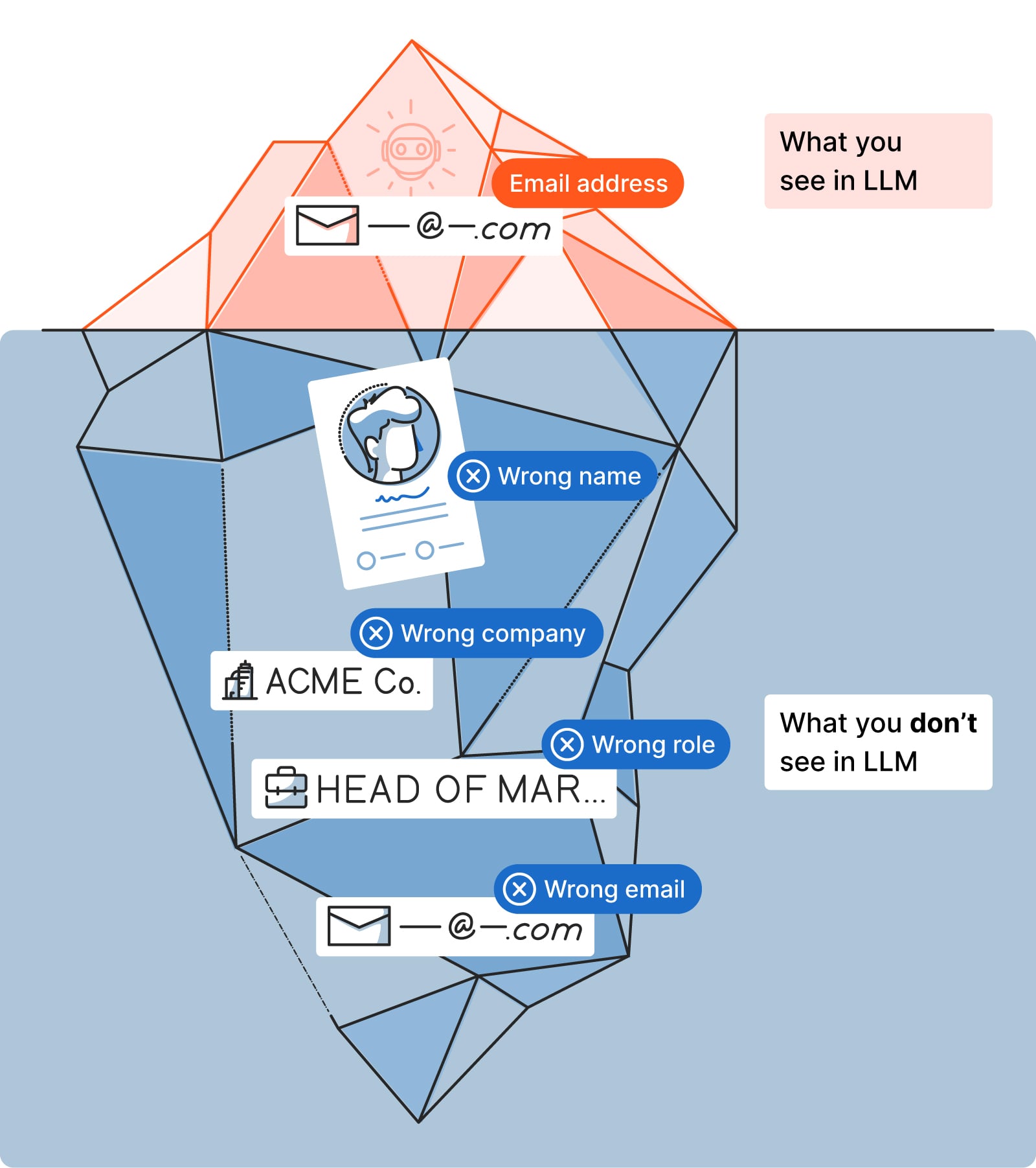
With the wrong contact (be it name, email address, job title, or company) there’s an iceberg tip situation that means your agents will build outreach sequences with fundamentally wrong information that leads to the type of personalization that turns off decision-makers.
Deliverability challenges
When your agents are working with incorrect information, this leads to fundamental challenges of getting into the inbox.
That means two things:
- Bounce rates skyrocket, as even valid email addresses decay at 22% a year without reverifying, or
- If you do reach the inbox, it’s going to contain incorrect information that will simply push your email into more spam folders, and increase email service providers’ likelihood of blacklisting your domain.
Incorrect data fed into your product (usage issues + monetary impact)
If you’ve used data that’s lacking data provenance inside your product, then the issues here will quickly surface as your customers interact with it.
When products like CRMs or marketplaces contain incorrect information, or information that’s not acquired through the correct means (without proof of the opposite), this will negatively impact product usage and contribute towards increasing churn as dissatisfaction sets in.
Damaged brand (company and personal) credibility
Lastly, whether you’re using agents for go to market outreach or inside your product, data without recorded origins is more likely to be incorrect, unverified, and pose a real risk to your brand.
Whether that’s your company or personal brand, operating with the wrong information leads to misunderstandings, at best, or can create a lasting impression that goes beyond the initial usage of that information.
Prepare for data provenance today
Throughout this guide we’ve talked about the role of data provenance in agentic go to market and its growing importance as we use AI to unlock the time, money, and quality improvements that the tooling promised.
As AI evolves, so too will the requirements of regulators when it comes to data protection. Taking steps today to create data provenance governance processes, training, and general awareness is a leap that will pay off in the future.
While you evaluate your agents, data sources, and systems, take the time to protect yourself as you seek the promised land of agentic go to market work.
Go to market data provenance FAQs:
What is data provenance vs lineage?
Data provenance is backwards looking at the origins of creation whereas lineage is forward consumption and transformation of data.
What are the two classes of data provenance?
Coarse-grained (workflow/process provenance) that records the steps, jobs, and tools that create a whole dataset, and fine-grained (data provenance) that record, for an individual data, which inputs contributed to its creation.
What is another word for data provenance?
There are a number of synonyms used for data provenance:
- Data lineage: Glossaries, like the National Library of Medicine in the US’ data glossary, presents it as an alternative term.
- Data pedigree: Combines data provenance with data quality, adding accuracy, correctness, completeness and timeliness to the data origin part of the definition.
- Chain of custody: The legal and forensic term for the same concept.
- Content credentials/provenance: The media-specific term for cryptographically signed provenance on images, audio and video.
What is an example of provenance?
With data provenance recorded, jane@acme.co would show the source of the email (a domain search), the verification status (for example, SMTP check on 27 Aug 2026), the lawful basis of collection (B2B legitimate interest) and the data decay (last verified on 26 Aug 2026).
Why is data provenance important for AI agents?
Data provenance gives AI agents accurate, trustworthy data from which they can run their tasks.
Does data provenance matter for training data too?
Yes, data provenance has been shown as a challenge for widely used software solutions, according to studies, where data usage cannot be accurately confirmed as compliant with its licensed purpose.



 Send cold emails with Hunter