Most of your lead list isn’t ready to buy right now. It’s a reality that few accept, but every one of your leads is at a different point in their buying journey.
A "book a call" sequence reaches the few who are ready, but alienates the majority.
Here’s what you need to know about the different buying modes in B2B email outreach, and how you can map your email sequences to where your leads are in the buying cycle, as part of our supporting guide to Hunter’s Outreach Planner.
Why this happens
Research from the LinkedIn B2B Institute and the Ehrenberg-Bass Institute puts the in-market share of B2B buyers at roughly 5% at any one time. That means the other 95% will buy eventually, but they’re in a different state of mind.
Gartner’s March 2026 sales survey adds another layer: 67% of B2B buyers now prefer a rep-free experience for early-stage tasks. They want self-service when they’re learning, and a seller when they have specific decisions to make.
Gartner has separately reported that bad prospecting actively damages buyer relationships. It offers yet another proof point for Hunter’s State of Email Outreach 2026, which found that decision-makers are turned off by overly pushy (read: salesy) outreach.
That’s because buyers are going through any one of five different buying modes.
The five modes B2B buyers cycle through
- Problem identification: They’ve started to feel a problem, but haven’t named it yet.
- Researching solutions: They have a rough sense of what they need, and they’re comparing options.
- Evaluating options: They’ve built a shortlist and are weighing one vendor against another.
- Final approval: They’ve picked a direction. They need internal buy-in before they can sign off.
- Competitor displacement: They bought from someone else, and the cracks are showing.
The reality is that your leads can move in any direction across these modes, creating a messy picture.
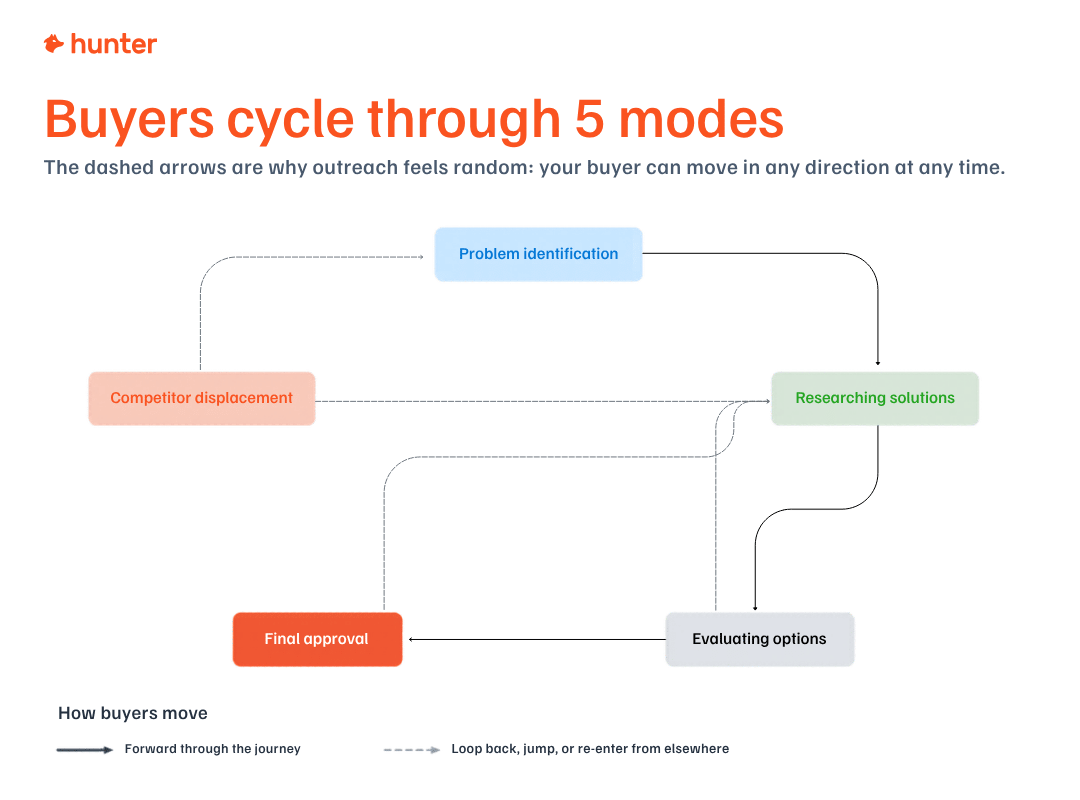
These aren’t stages that move from left to right at a uniform rate.
A buyer can drop out of final approval after a committee meeting, jump back to researching solutions, and end up in competitor displacement six months later.
Your leads list always has people in all five modes simultaneously.
How company size affects the buying journeys
A second factor to consider when building your lead lists is that the size of the target company the lead sits in will change the dynamics.
As buying modes change throughout the year – typically, the end of the year is quieter, the start of the year is busy, the middle of the year indifferent – company size will also affect the buying journey.
Here’s how it breaks down:
Sources: Optifair, HockeyStack, Gartner, Attainment Labs, and Arcade.
This maps out to a different buying cycle based on the size of the company you're targeting:
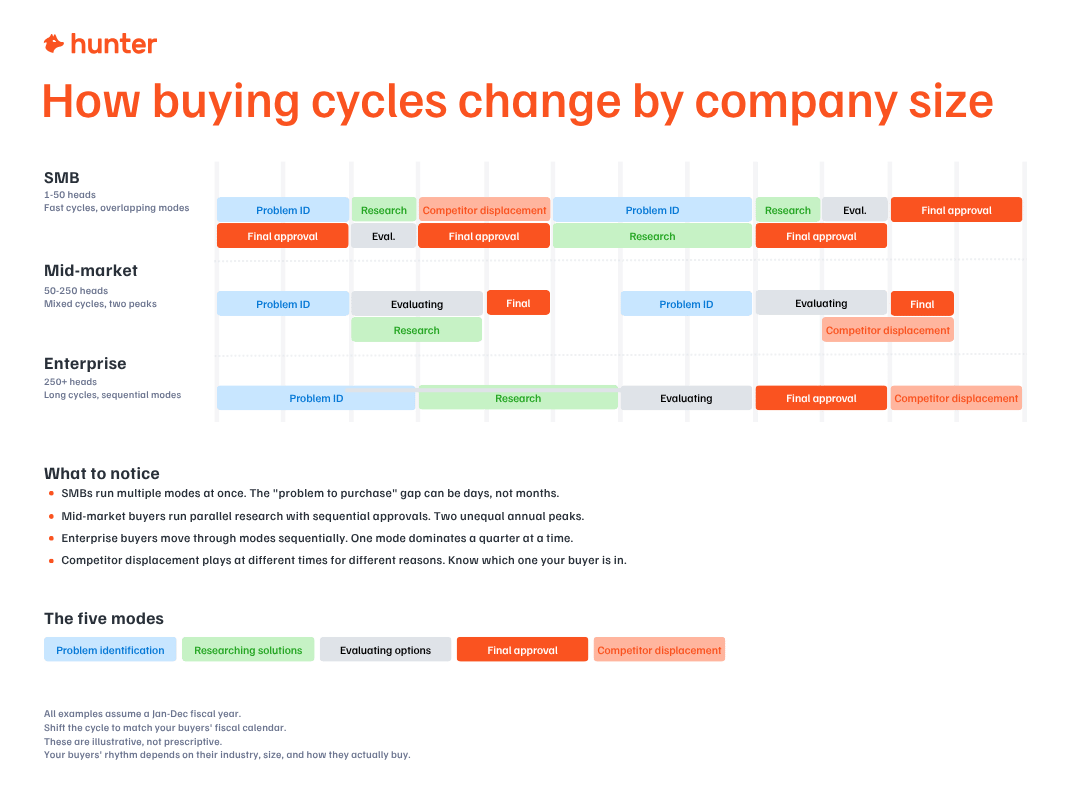
SMBs cycle fast and run modes in parallel. Mid-market splits parallel research from sequential approvals. Enterprise moves through one mode per quarter.
Each mode wants a different sequence
The different buying modes require different messaging and campaigning, as our comparison table shows.
How to apply this
Making sense of the buying modes and sequences you can run enables you to approach outreach in ways few of your peers will. Run through these steps
- Map your buyers’ fiscal calendar to the five modes.
- Build lists and one sequence per mode: a relationship-builder for problem identification, value-first content for research and evaluation, direct outreach for final approval, and switcher-aware copy for competitor displacement.
- Run them in parallel. Same sending domain and same week, but different lists. Buying mode is the segmentation variable that matters most.
- Watch reply rate per mode rather than overall. The same sequence will perform differently across modes. That’s the point.
What this changes
If you want to simplify this process, download a free copy of Hunter’s Outreach Planner, which gives you a complete 12-month plan on how to send sequences that are mapped to your buyer’s world.
Download your copy today and map your year.

 Send cold emails with Hunter