You've got a great email, a sharp subject line, and a sequence that's ready to go. There's just one problem: you're sending it to the wrong people.
We analyzed 31 million outreach emails for the State of Email Outreach 2026 report. The companies getting replies aren't sending the most emails - they're sending to the right people.
61% of decision makers say the outreach they receive is irrelevant. Only 28% feel those emails add any value at all. That's roughly three out of four outreach emails landing with zero impact.
The answer isn't better copy or a more aggressive follow-up schedule - you need better targeting. Once you know precisely who you're writing to, everything else gets easier.
We covered this in a live session, Finding Your Next Best Buyer, with Matt Tharp (CEO) and Rui Costa (Product Manager). Here are 10 practical ways to sharpen your targeting, backed by the data.
Want to watch the replay on-demand? Click below.
Stop chasing "everyone"
1. Find your beachhead, not your total addressable market
Most teams build their outreach lists at the wrong level. They start with a broad total addressable market (TAM), pull thousands of companies, and blast the same message to all of them. It doesn't work.
Email sequences with fewer than 100 recipients generate 158% more replies than sequences with 500+.
The recipients don't know the list size, so something else is going on. Smaller lists have more overlap between recipients. More overlap means your message lands with a higher percentage of the people who read it.
Rui introduced a concept in the session called the Prioritized Obtainable Market (POM). It's the segment of your market you can genuinely dominate. Not capture - dominate.
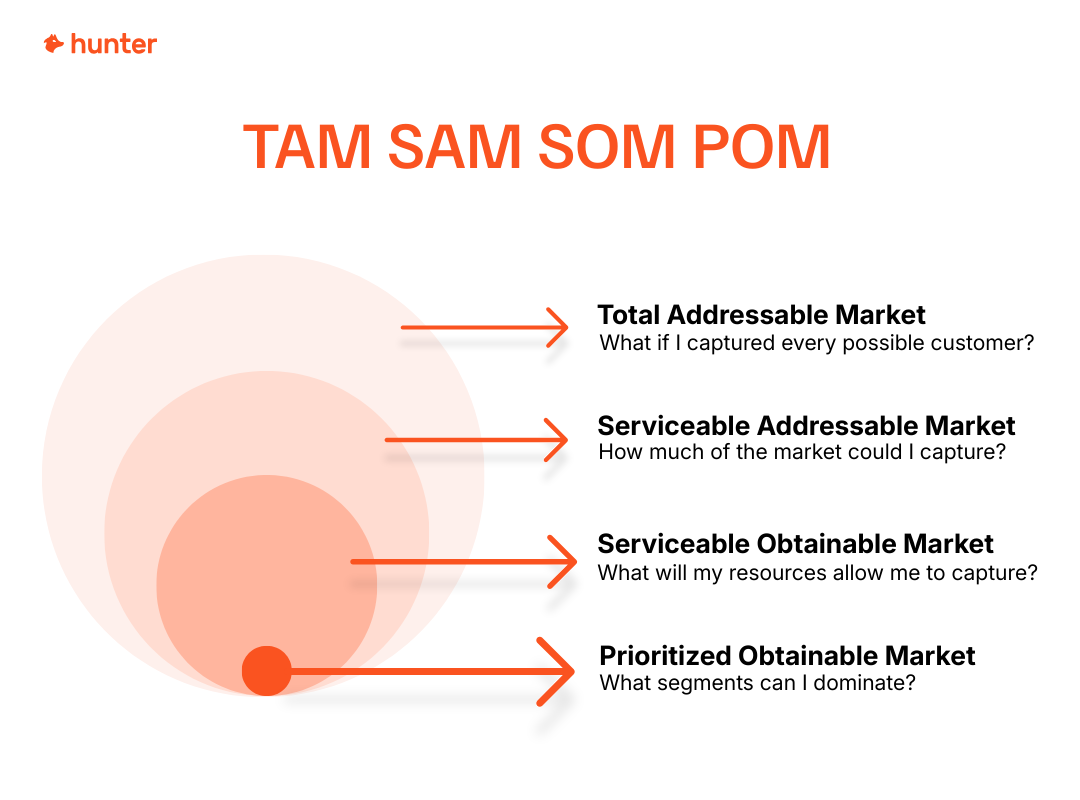
Your POM has three characteristics:
- These companies have the problem you solve, and it's urgent
- They have the budget and authority to act
- You can write a message so specific it feels like you wrote it for each person individually
To find yours, work through four levels:
- Start with the total addressable market (every company that could theoretically use your product)
- Narrow to the serviceable addressable market (companies you can actually reach).
- Then the serviceable obtainable market (what your resources allow you to capture)
- Finally, drill into the POM: the segment you can own.
It's not about how many companies could use this, it's about which segment can I own
2. Let your best customers define your ICP
If you already have customers, you've got a shortcut. Take your 10 to 20 best clients, put them into your prospecting tool, and look for patterns. How are they labeled by industry? What size are they? Where are they based? What tech are they running?
When you apply those filters in Discover and your existing customers show up in the results, you know you're on the right track. Brandon Murie, Founder of GoodJuju, described this approach:
"I first go through the keywords and include or exclude filters in Discover. I add a negative keyword and I can see the list getting cleaner and cleaner. Seeing some of our clients appear in the results tells me my targeting was exactly right."
Think of it as a validation moment. Your ICP isn't just a hypothesis anymore - it's something you already have proof for.
Define the right company and the right person
3. Work from market to company to person
Rui walked through a framework that turns a vague ICP into an actionable target list. You move through three layers: market, company, then person.
Market is the space you're playing in - the industry or category that defines your potential buyers. Define it broadly enough to have volume, but specifically enough to have focus.
Company is where you get precise. Apply your filters here: industry, size, location, founding year, keywords, and technology.
Person is the decision maker. Not just the most senior person at the company. The person who owns the problem, feels it every day, and has the authority to buy.
Rui used a fictional product called "Proposedly" to bring this to life. It's a proposal tracking tool for sales teams. Instead of targeting "every company that sells something," the team narrowed sharply. The target: marketing and creative agencies, 10 to 15 employees, US-based, founded 2015-2022. That took 10,000 potential companies down to 70 highly relevant ones.
Why agencies? They send proposals constantly. Why that size? Big enough to have volume, small enough that nobody's bought the enterprise solution yet. Why founded between 2015 and 2022? Companies founded before 2015 have lived with the problem long enough to accept it. Companies founded after 2022 are too new to feel it.
Every filter has a reason. That's what separates a useful ICP from a generic one.
4. Find the people whose hair is on fire
Not every prospect is equal, even inside the right company. Rui's framework breaks this into three layers: problem, pain, and impact.
Problem: What specific business challenge does this segment face? For Proposely: agencies send proposals and have no visibility into what happens next.
Pain: How acutely do they feel it? Is it daily or occasional? Missing leads creates revenue gaps that are hard to ignore.
Impact: What does not solving it cost them? Loss of market share, more founder-led sales, layoffs.
You're looking for the person who needed your solution yesterday. Not someone who might be "interested." Someone desperate.
5. Use hiring, funding, and tech signals to prioritize
Once you know your ICP, you need to figure out who to contact first. Intent signals help here.
Hiring signals pain. A company hiring for the role you serve is signaling an active need. If they're downsizing, that can also point to a problem you solve. Filter your lists by hiring activity.
Funding signals budget. Recently funded companies have money and growth pressure. But don't email them the day after they raise - everyone does that. Think about what they'll need 30 to 60 days post-funding. That's when your outreach should land.
Competing or missing tech signals fit. If a company uses a competitor or a complementary product, that's a buying signal. Even the absence of a tool can qualify them. No marketing system in place and you sell marketing tools? That gap is your opening.
Social media signals relevance. If your target leads are raising concerns on LinkedIn about an issue you solve, the pain is real and top of mind. Use it for personalization, but keep it genuine - automated LinkedIn scraping at scale loses relevance fast. Another reason to keep your lists small.
Use this to find those with a willingness to buy, as shown below:
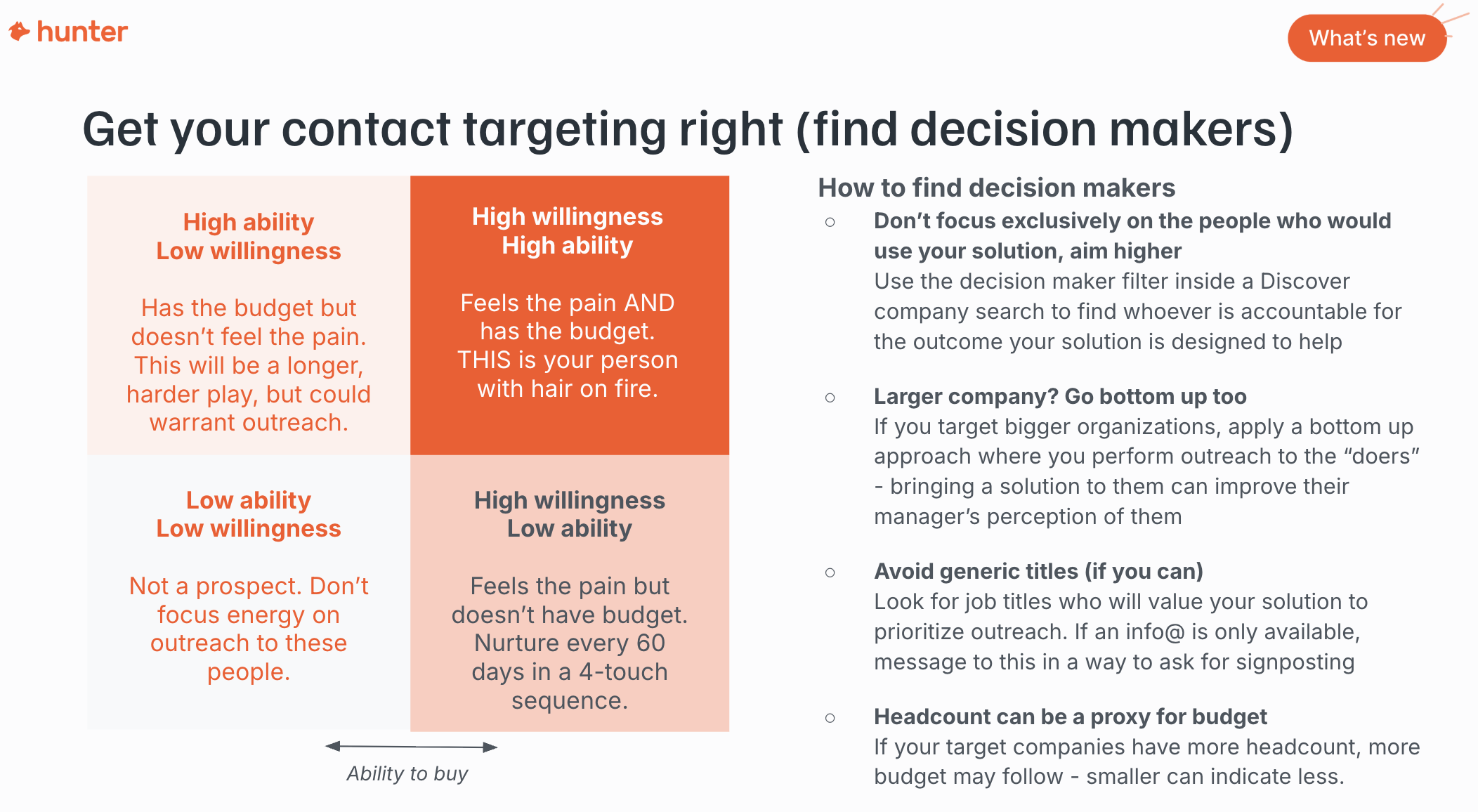
Your ideal target has a willingness and ability to buy - they feel the pain and have the budget. Someone with high willingness but low ability is worth nurturing over time. Someone with neither isn't a prospect. Don't waste outreach on them.
Avoid the three most common targeting mistakes
6. Contact more than one person at each company
Emailing two people per company at the same time improves reply rates by 46%.
Most teams target one person: the decision maker. But that puts everything on one contact. They might not be there, might be too far from the problem, or might just miss your email.
The company is what you're targeting. The person just happens to be the conduit to the outcome.
Reach the decision maker, but also reach an influencer.
At smaller companies, that might be the owner and the head of business development.
At larger companies, consider going bottom-up. C-suite executives at big organizations are often the farthest from day-to-day pain.
Target the doers instead - if they see value, they'll carry your message upward.
A few practical tips for finding the right contacts:
- Use the decision maker filter in Discover to find whoever is accountable for the outcome your solution helps with
- At larger companies, target both top-down and bottom-up
- Avoid relying on generic titles or info@ addresses - if that's all you've got, use the email to ask for a signpost to the right person
- Use headcount as a proxy for budget. Revenue data for private companies is unreliable. Headcount is self-reported, public, and on LinkedIn
7. Send multiple sequences, not one campaign
Here's the pattern Matt sees all the time: a team sends one campaign to thousands of contacts, gets a low reply rate, and decides outreach doesn't work.
Outreach works. One-shot blasts don't.
Only 2 to 8% of your market is actively looking for a solution at any given time. Your first email might land on a bad week. The timing might just be off. Multiple sequences give you more shots at catching the right moment.
Emails that contain custom attributes speaking to specific pain points improve reply rates by 56% versus non-personalized emails.
There's an important distinction here between relevance and personalization. Relevance means the topic matters to the recipient. Personalization means the email feels like it was written specifically for them. You need both.
When you keep your lists small and build one sequence per segment, relevance is baked in. Everyone on a list of 70 marketing agencies shares the same core problem. Your message speaks to that problem by default. Then you layer in personalization - the recipient's name, their company, a reference to something specific about their situation.
Matt's recommended cadence: a three- to four-message sequence per quarter. Space the touches out. Don't bang on doors daily. Come back next quarter with a new angle.
8. Document who is NOT your target
Knowing who to exclude is just as valuable as knowing who to include. It's the piece most teams skip entirely.
Think about each exclusion filter as removing noise from your list:
- Wrong company size. Too small and they won't have the budget. Too big and procurement cycles may be too long for your sales process.
- Wrong industry. The company size and person might be right, but if the industry is just different enough, they won't feel the same pain. Probably needs a different message - or no outreach at all.
- Wrong location. Don't spend resources targeting companies you can't serve.
- Locked into contracts. You can't always see this, but you know your industry. If most of your audience signs annual contracts, factor that into your timing.
- Wrong technology fit. If a company uses a tool that makes your solution redundant, exclude them.
In Hunter's Discover tool, you can use keyword excludes to do this precisely. Going after pipe manufacturers? Exclude "plastic" if you only serve metal. Targeting creative agencies? Exclude "branding agency" if your product doesn't fit that niche.
Put it all together
9. Keep your segments between 50 and 100 people
The data is clear: smaller lists win. But how small is small enough?
Rui recommended 50 to 100 people per segment. At that size, you can write one message that genuinely resonates with everyone on the list. They share the same industry, the same company profile, and often the same job title. Their problems overlap enough that a single well-written email feels personal to each of them.
That doesn't mean you can only reach 100 people total - it means each campaign targets 50 to 100. Run multiple campaigns in parallel, each aimed at a different segment with its own message. Ten campaigns of 70 people will outperform one campaign of 700. Every time.
If you're scaling rapidly and need to process thousands of leads, Matt shared a practical approach. Build a large list at the TAM level, then segment it with one or two levers like job title, geography, or industry. That gives you manageable sub-lists with enough shared context to tailor the message. Then use personalization within each sub-list to take it the rest of the way.
10. Run through this checklist before every campaign
Before you create your next list or send your next sequence, go through these questions:
- Have I defined my ICP tightly enough? Can I describe the exact company and person?
- Is my list under 100 recipients? If not, can I segment further?
- Am I targeting the segment I can own, not just the market I can reach?
- Have I separated willingness to buy from ability to buy?
- Am I contacting at least two people per company?
- Have I documented who is NOT my target?
- Does my message speak directly to the pain this specific segment feels?
- Am I planning multiple sequences, not just one campaign?
- Am I using intent signals (hiring, funding, tech) to prioritize who to contact first?
- If I search my own filters, do my best existing customers show up in the results?
If you answered no to any of these, that's where to focus before sending a single email.
What it all comes down to
Better targeting doesn't just improve your reply rates - it changes the entire equation.
When you send to smaller, more relevant lists, your messages are easier to write. Your reply rates climb. Your recipients feel respected instead of spammed. And your outreach becomes something people actually want to engage with.
The data backs this up across the board. Smaller lists, more contacts per company, custom attributes, multiple sequences - each one moves the needle on its own. Together, they compound.
Start with your best customers. Define the segment you can own. Find the people whose hair is on fire. Then send them a message that proves you understand their problem.
Watch the replay
There's plenty more to uncover about finding your next best buyers. This is just the beginning, but you can keep going by watching the full recording below.


 Send cold emails with Hunter