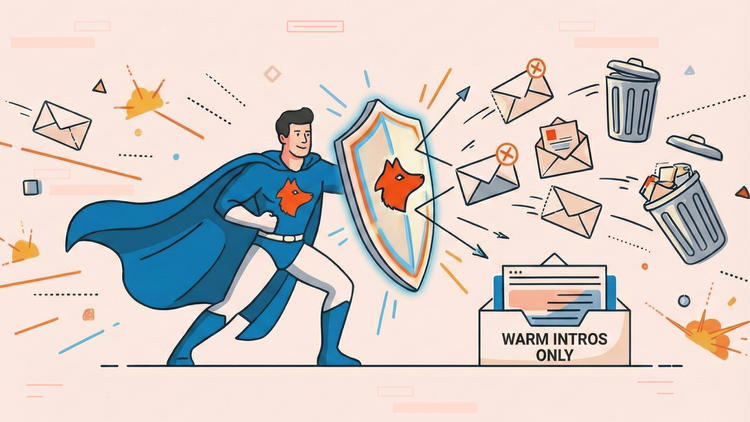
How you can stand out by sending less, caring more, and earning permission.
Cold email in 2026 has a branding problem. Not because “email is dead,” but because most advice still pushes the same playbook:
- Volume
- Templates + spintext
- AI writes the email and “research”
- Gimmicks (hello, the FWD chain)
- “Don’t worry about verifying data”
That playbook optimizes for output, not outcomes. It creates the exact experience your prospects hate: irrelevant messages, sent too often, to the wrong people, from people who haven’t earned attention.
So here’s the opposite approach: become the anti–cold emailer.
You’ll send fewer emails, get more replies, and protect your reputation while everyone else burns theirs.
TL;DR summary
Cold email in 2026 is broken because most advice still pushes volume, templates/spintext, AI-written “research,” gimmicks, and ignoring data quality. That optimizes for output—not outcomes—so prospects get irrelevant emails, too often, from senders who haven’t earned attention.
The fix: become an anti–cold emailer. Send fewer emails, earn more replies, and protect your reputation by:
- Targeting smaller lists with real relevance (industry + role + trigger; “why you, why now”).
- Opening with credibility in the first line (proof, a credible action, or a clear constraint).
- Running a nuisance test to avoid sending spammy messages.
- Spending more time researching than writing (G2 reviews, annual reports, industry news, your own data) and emailing one clear hypothesis.
- Using permission-based CTAs (“Can I send…?”) instead of links/asks in email #1.
- Verifying data to protect deliverability + trust.
- Keeping emails plain text, simple, and specific (with stats you can explain).
- Prioritizing warm signals + multichannel (LinkedIn + email with real context).
- Avoiding gimmicks (fake Re:/Fwd:, FWD chains, clickbait subjects, breakup emails, fake urgency, “wrong person?”, calendar ambushes, fake name-drops, attachment bait, mass Looms).
2026 will reward: short subjects, credibility-first openers, one hypothesis, low-friction permission CTAs, and ~3-email sequences. Tools like Hunter Sequences help operationalize this with verified data and respectful sequencing.
How to become an anti-cold emailer
1) Smaller lists, deeper relevance
Start with this rule: if your list is “big,” your message is probably generic. The anti–cold emailer builds smaller lists and wins on relevance.
Relevance isn’t “personalization” like “Loved your recent post!” It’s speaking in the language the recipient expects based on their industry + role. A founder cares about runway and focus. A RevOps lead cares about process and data hygiene. A sales leader cares about pipeline quality and ramp time.
If you can’t explain why this person, at this company, right now is a fit in one sentence, don’t email them.
2) Use the first line to establish credibility (not small talk)
Most emails waste the first line on fluff. In 2026, your first line should answer: “Why should I take you seriously?”
Credibility can be:
- a relevant outcome (“We helped 12-person SaaS teams cut no-show demos by 18%.”)
- a credible action (“I’m running a research project on outbound in fintech.”)
- a credible constraint (“I only reached out to 17 VP Sales in payroll software.”)
Example first line:
“[[First Name]] — I’m benchmarking reply rates for SaaS teams under 50 people, and your team’s hiring signals suggest outbound is a priority this quarter.”
No hype. No vague “synergy.” Just a reason they should keep reading.
3) Run a “nuisance test” before you hit send
Here’s a simple nuisance test to stop yourself from spamming:
- Would I be annoyed to receive this?
- If I got this 10 times this week, would I trust the sender less?
- Does this ask for attention before earning it?
- Is the message specific enough that a stranger could tell who it’s for?
- If they reply “not now,” do I have a respectful next step?
If you fail the nuisance test, your email isn’t “bold.” It’s a nuisance.
4) Spend more time researching than writing
Anti–cold emailers don’t “personalize.” They research.
Good sources in 2026 aren’t mysterious:
- G2 reviews to mirror real pain (“too many bounced emails,” “data is outdated,” “tool is hard to adopt”)
- annual reports / earnings calls for priorities, budgets, and risk
- industry news for timing and urgency
- your own research (surveys, benchmarks, teardown studies)
Then you do something most people won’t: you reference it and tie it to a single hypothesis.
“Noticed you’re expanding into Germany + hiring for RevOps — usually that’s when list quality and segmentation become make-or-break.”
5) Experiment with hooks that earn attention
Most hooks are self-serving (“Book a demo”). Anti–cold emailers lead with value or relevance.
Hooks worth testing in 2026:
- Two-week “free trial” of your service (clear scope, clear outcome)
- Invite to a roundtable (you’re gathering insights, not pitching)
- Invite to a podcast for research (not “content”)
- A lead magnet that’s actually useful (benchmarks, teardown, checklist)
- A warm reference (someone they know, or a shared context)
The key is intent: “I’m here to learn / help” beats “I’m here to take.”
6) Permission over assumption
Cold email becomes calmer when you stop assuming you’ve earned their time.
Instead of dumping links and asks in email one, try permission:
“If it’s useful, can I send a 90-second Loom showing what I noticed?”
“Can I share two examples from other [[industry]] teams?”
“If I’m off, tell me and I’ll disappear.”
You’re not lowering ambition. You’re lowering friction.
7) Verify your data or lose before you start
In 2026, bad data is the fastest way to destroy deliverability and credibility.
If your email hits the wrong person, wrong role, wrong company, or bounces repeatedly, the message you’re sending is: “I don’t care.” Verify emails. Clean your list. Respect the basics. The anti–cold emailer treats data hygiene like reputation management (because it is).
8) Plain text, simple structure, real numbers
Plain text wins because it looks human and reads fast.
Use short lines. One idea per paragraph. And yes—use stats (but only the ones you can explain). Numbers build trust when they’re specific and relevant.
9) Focus on warm signals and multichannel by default
The easiest “cold” email is the one that isn’t truly cold.
Warm signals to prioritize:
- webinar/event attendees
- hiring signals (roles that imply a new initiative)
- referrals and intros
- LinkedIn engagement that reasonably suggests interest
- referencing a LinkedIn connection request you actually sent
Then combine LinkedIn + email to increase visibility without increasing spamminess. A simple pattern: connect → short message → email with context → follow-up referencing the prior touch.
10) Avoid gimmicks
Stop and think about the way that trends work. Someone leads the way, it stands out, and then pretty soon everyone else follows. As more people follow, the trend eventually waters down the impact of whatever the originator intended.
That applies to cold email too. When an influencer shares a system or a hack that works today, it's naturally touted as the next greatest trick in cold email. The only problem is that as more people follow this approach, it weakens the effectiveness.
This is what I mean by gimmicks. Look in your inbox and you'll see:
- Fake “Re:” / “Fwd:” subject lines: Pretends there’s an existing thread or internal context.
- The FWD email chain format: Stages a fake internal back-and-forth to look “real” or urgent.
- Clickbait curiosity subjects: (“Quick question”, “Thoughts?”, “Are you free?”)Optimized for opens by withholding context.
- Breakup emails (“Should I close your file?” / “Last try.”): Uses manufactured drama/guilt to force a response.
- Fake urgency / fake deadlines (“EOD”, “before Friday”, “last chance”): Creates pressure without a real reason.
- The “wrong person?” trap: Tries to turn the recipient into your internal router.
- Calendar ambush (dropping a meeting link or sending an invite in email #1): Tries to skip consent and jump straight to a meeting.
- Fake name-drops / implied referrals: “John suggested I reach out” (when John didn’t).
- Attachment bait (“proposal attached”): Uses an attachment to trigger curiosity (and sometimes avoid scrutiny).
- “Personalized video” at scale (templated Looms): Leverages the idea of effort without the real specificity.
If you need a trick to get attention, you haven’t earned attention.
How anti–cold emailers will win in 2026
Here’s what I predict will separate high reply rates from everyone else:
- Best reply rates: short subject lines, a credibility-first opening line, one clear hypothesis, and a low-friction CTA (often permission-based).
- What most senders will do anyway: keep blasting templates, leaning on AI to “personalize,” and scaling volume until deliverability collapses.
- Fastest way to get unsubscribed/rejected: vague value props, link-heavy first emails, fake familiarity, and “checking in” follow-ups with no new value.
- Sequence length: the best outcomes will cluster around 3 emails. Past that, replies drop and negative signals rise.
- Follow-up performance: reply rate will usually peak on follow-up #1 or #2, then decay sharply unless each follow-up adds new information.
- Daily volume limits: you won’t “earn” the right to double volume just because people opened/replied—reputation is fragile. Scale accounts and systems carefully, not ego.
- AI-written emails: they’ll increasingly blend into the “same-sounding” pile. The bigger risk isn’t just detection—it’s that AI makes everyone sound identical, which kills trust.
- Links in outreach: links will work best when they’re optional and tied to trust (e.g., a short Loom) rather than “read my case study.”
- Multichannel references: more top performers will reference a LinkedIn touchpoint because it signals you’re not hiding behind volume.
10 cold email plays that scale but don't spam
Let's get away from hacks and systems. Let's move towards experiments. Here are 10 you can trial based on what's going to work in 2026:
1) The “17-person list” play (credible constraint)
What you do: Build a micro-list (10–25 people) in one niche (role + industry + trigger).
Why it works: The constraint is credibility.
Email angle: “I’m only reaching out to 17 [[role]] in [[industry]] because of [[trigger]].”
CTA: “Worth asking 1 question?”
2) The “one pain, three receipts” play (G2 + proof)
What you do: Pull 3 short “receipts” from public reviews (G2, community posts, job descriptions) that all point to the same pain.
Why it works: You’re mirroring reality, not making claims.
Email angle: “I keep seeing [[pain]] come up for [[industry]] teams—here are 3 examples.”
CTA: “Is this true for you too, or totally off?”
3) The “timing trigger” play (hiring/news = relevance)
What you do: Email only when there’s a real trigger: hiring SDRs, new market launch, new RevOps hire, funding, new product line, competitor move.
Why it works: You’re not random—you’re timely.
Email angle: “Saw [[trigger]]. Usually that’s when [[problem]] shows up.”
CTA: “Want 2 ideas that have worked for similar teams?”
4) The “permission-first Loom” play (but only after they say yes)
What you do: Don’t send the Loom in email #1. Ask permission to send a 90-second Loom.
Why it works: It’s respectful and intriguing without clickbait.
Email angle: “If it’s useful, can I send a 90-sec Loom with what I noticed?”
CTA: “Should I?”
5) The “two-week pilot with boundaries” play (free trial of service)
What you do: Offer a 2-week pilot with a strict scope and measurable output (not “free consulting”).
Why it works: It’s value-forward without being vague.
Example scope: “We’ll clean/verify a 200-contact list + write 3 variants + set up a 3-email sequence.”
CTA: “If I share the exact scope + success criteria, would you consider it?”
6) The “roundtable research invite” play (learn-first)
What you do: Invite them to a small roundtable (5–7 people) around a specific topic they care about.
Why it works: It flips the dynamic: you’re gathering insight, not extracting a meeting.
Email angle: “I’m hosting a small roundtable on [[topic]] with [[peer roles]]. No pitch—just shared tactics.”
CTA: “Want an invite?”
7) The “benchmarks for your niche” play (lead magnet that isn’t fluff)
What you do: Create a tiny, specific asset: “Reply rate benchmarks for [[role]] in [[industry]]” or “3-email sequence teardown for [[use case]].”
Why it works: It’s useful even if they never buy.
Email angle: “I pulled benchmarks from [[source]] + our own data for [[niche]].”
CTA: “Can I send it?”
8) The “single-question diagnostic” play (low friction, high signal)
What you do: Ask one high-quality diagnostic question that a real expert would ask.
Why it works: It signals competence and reduces cognitive load.
Examples:
- “Where do replies drop most: email #1 or follow-ups?”
- “Are bounces a bigger issue than low replies?”
- “Do you segment by role language or keep one message?”
CTA: just the question.
9) The “multichannel courtesy” play (LinkedIn → email with context)
What you do: First touch is a LinkedIn connection request with a plain note. Then email referencing it (no gimmicks).
Why it works: It creates legitimate context without faking familiarity.
Email angle: “I sent a LinkedIn connect yesterday—emailing in case you don’t check DMs.”
CTA: “Okay if I ask one quick question?”
10) The “three-email maximum” play (respect + differentiation)
What you do: Tell them upfront you’ll stop after 3 emails. Then actually stop.
Why it works: It’s a rare signal of respect (and you stand out immediately).
Email angle: “I’ll send max 3 emails—if it’s not relevant, I’ll disappear.”
CTA: “Is this even on your radar?”
Get ahead with Hunter's Sequences
If you want to stand out in 2026, don’t be better at cold email tricks.
Be better at being a human: smaller lists, real research, credibility early, permission-based asks, verified data, and simple plain-text writing that respects the reader.
You can start that with Hunter's Sequences, an email tool that's going to help you send cold emails that follow these best practices, and earn the replies you need.
That’s the anti–cold emailer. And it’s the only version that scales without burning you.




 Send cold emails with Hunter